
Mountain bike pedals: flat, clipless or hybrid


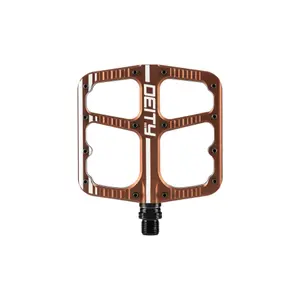


On the trails, mountain bike pedals have to hold your foot despite impacts, mud and constantly changing pressure. Pinned flat pedals leave your foot free and reassure you on descents, clipless pedals with a two-bolt cleat lock it in for efficient pedalling in cross-country, and platform or dual-sided models bridge the gap between the two. Choose according to your terrain, then check compatibility with your shoes.
Flat or clipless: which mountain bike pedals for your riding?
- Cross-country and marathon: light clipless pedals, with an open mechanism that sheds mud, for efficient pedalling over long distances.
- Trail and enduro: clipless pedals surrounded by a platform, which support the shoe in committing sections, or pinned flat pedals if you like to put a foot down.
- Downhill, freeride and dirt: wide, concave flat pedals dominate, even if many downhill racers ride clipless pedals with a wide cage.
- Leisure riding and electric mountain bikes: generous flat pedals or dual-sided pedals, to ride in walking shoes and set off easily on a climb.
Flat mountain bike pedals: platform, pins and concavity
A flat pedal's grip comes from its pins, small screws spread around the edge that bite into the sole. They can be replaced when they wear or bend, and their length can be adjusted on some models. A slightly concave platform, thinner in the middle, locates the foot and stops it rolling off the sides. A thin profile limits pedal strikes against rocks and lowers the foot, which improves the feeling of stability.
Aluminium bodies allow the thinnest profiles; composite bodies, more affordable, stand up well to impacts. Platform size also matters: a large foot needs a wider surface, and some brands offer their flat pedals in two sizes. To get the best from them, pair them with flat-soled shoes in soft rubber, without deep lugs.
Clipless mountain bike pedals: two-bolt cleats and mud clearance
For mountain biking, the cleat is fixed with two bolts and recessed into a treaded sole: you can walk and push the bike without slipping. Shimano's SPD standard, adopted by many brands, dominates. The pedals usually engage on both sides and their mechanism is designed not to clog in mud. Shimano offers two cleats: the SM-SH51 releases only by heel rotation, while the SM-SH56, known as multi-release, also frees the foot when you pull it in other directions, which is reassuring while you learn.
For trail and enduro, models with a cage or an extended platform offer stable support even when the foot is not clipped in, and a few pins improve the hold of the shoe. Release tension is adjusted with a screw: softer for beginners, firmer for riders who put a lot of force through the pedals.
Dual-sided, magnetic or power meter: other mountain bike pedals
Dual-sided pedals, with a cleat on one side and a smooth or pinned face on the other, suit riders who switch shoes. Magnetic pedals hold a steel plate bolted under the shoe: the foot stays in place without a mechanism and is released by sliding it sideways or lifting it. Finally, mountain bike pedals with a power meter, compatible with SPD cleats, measure your watts without changing your chainset, to track your training in cross-country as well as gravel.
The other contact points of a mountain bike
Pedals, grips and saddle are the mountain biker's three contact points. Grips and bar ends ensure your hold on the handlebar, and MTB saddles your comfort when seated. To compare all pedal families, including kids' and city models, see bike pedals; if you also ride on tarmac, road bike pedals cover three-bolt systems in detail, and BMX pedals the flats for pump track and skatepark.
Which mountain bike pedal brand should you choose?
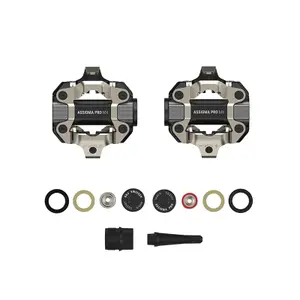
Favero brings power measurement to mountain biking and gravel with the Assioma PRO MX, with an aluminium body and compatible with SPD cleats: the single-sensor MX-1 can be upgraded to the dual-sensor MX-2.
Shimano, the originator of the SPD system, offers the double-sided PD-M540, the XT M8120 with an extended platform, the ME700 with a cage for trail riding, as well as flat pedals such as the PD-GR400 and GR500.
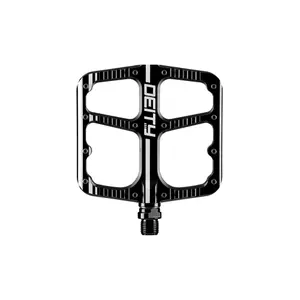
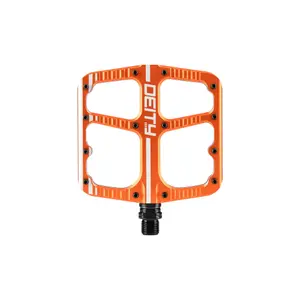
Deity designs flat pedals for downhill and enduro, such as the Flat Trak, Supervillain and Black Kat, as well as the Deftrap, with a nylon composite body and replaceable steel pins.
Magped, an Austrian brand, has made the magnetic pedal its speciality: a magnet holds a plate bolted under the shoe, and its Sport2, Ultra2, Enduro 2 or Gravity models vary according to magnet strength.
Funn covers cross-country with the Tactic XC, a compact SPD pedal, offers the Ripper V2, SPD on one side and flat on the other, and thermoplastic flat pedals such as the Taipan.
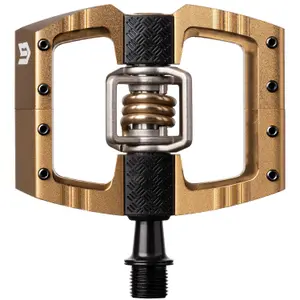
crankbrothers offers the Mallet DH, a clipless pedal with a wide platform, in a signature edition for rider Loïc Bruni, and the Stamp flat pedal, available in two sizes depending on shoe size.
Mountain bike pedals on sale
End-of-line mountain bike pedals join MTB components clearance, with reduced-price grips, saddles and seatposts. Recently listed models are in new arrivals. Switching to clipless pedals or renewing a pair of flats costs less during the seasonal sales or on Black Friday.
Frequently asked questions
Flat or clipless pedals for beginner mountain bikers?
Flat pedals are the most common choice for beginners: they let you put a foot down without thinking and help you develop good bike handling technique. Clipless pedals can come later, starting with low tension and multi-release cleats.
Which shoes for flat pedals?
Shoes with a flat sole in soft rubber, without big lugs, into which the pins can bite. Ordinary trainers slip more and deform; hiking boots with lugs do not sit flat across the whole pedal.
Are clipless pedals suitable for electric mountain bikes?
Yes, but many riders prefer flat or dual-sided pedals: assistance makes restarting on climbs easier and you often put a foot down in slow, technical sections. The choice depends mainly on the terrain and how confident you feel.
How do you maintain mountain bike pedals?
Rinse off the mud without a pressure washer, which drives grease out of the bearings, then dry them. Lightly lubricate the springs of clipless pedals and check that the pins are tight. A pedal that develops play or turns poorly needs its bearings or bushings serviced.
Are mountain bike pedals suitable for gravel?
Yes. Clipless pedals with a two-bolt cleat are widely used in gravel, as they make it easy to walk when carrying the bike and during breaks, with treaded-sole shoes.







