
Bike pedals: flat, clipless and power meter


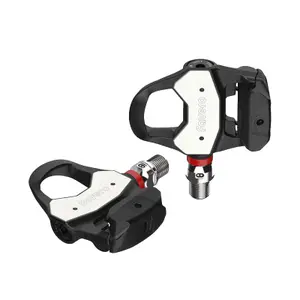


Bike pedals come in four main families: flat, clipless, dual-sided and power meter pedals. Flat pedals accept any shoe, clipless pedals lock onto a cleat bolted under the sole, dual-sided pedals combine the two, and power meter pedals measure your watts with every revolution. Choose the system according to how you ride, road, MTB, city or BMX, then check the thread of your cranks.
Which type of bike pedals for which kind of riding?
Choosing a pedal depends first on how you want to stay connected to the bike:
- Flat pedals: the foot rests on a platform and stays free. This is the solution for the city, leisure rides, BMX and a good part of mountain biking, with ordinary shoes or shoes with a grippy sole.
- Clipless pedals: a cleat fixed under the shoe engages in a spring mechanism; twisting the heel outwards releases the foot. They dominate on the road, in gravel and in cross-country mountain biking.
- Dual-sided pedals: one clipless side and one flat side, to alternate between journeys in trainers and rides in cleated shoes. They are also known as hybrid pedals.
- Power meter pedals: clipless pedals fitted with strain gauges that measure the force applied and the cadence, then send the power to a bike computer.
Then come more specific uses: kids' pedals with a smaller thread, folding pedals for parking a bike in a hallway, exercise bike pedals, or pedals with toe clips and straps for a vintage bike or a track fixie.
Flat or clipless pedals: what difference does the system make?
With clipless pedals, your foot always keeps the same position over the axle: it does not slip over bumps or in the rain, and you can follow the pedal all the way round when accelerating. Your pedalling becomes more consistent, especially over long distances. In return, you need compatible shoes and a few rides to make the release movement automatic; most beginners experience at least one fall at a standstill.
Flat pedals let your foot position itself and come free instantly. In technical mountain biking, they give you the confidence to put a foot down in a corner or jump off the bike if you lose balance. In town, they are happy with your everyday shoes. Neither system is superior: each suits a type of riding and a preference.
3-bolt or 2-bolt cleats: one system per type of shoe
Two standards share the clipless pedal market. On the road, the cleat is fixed with three bolts under a stiff-soled shoe: wide and protruding, it spreads the pressure over a large area but makes walking awkward. Look's Keo and Shimano's SPD-SL systems are based on this principle, each with its own cleats. For mountain biking, gravel and touring, the two-bolt cleat, popularised by Shimano's SPD system and adopted by many brands, is small and recessed into a treaded sole: you can walk almost normally.
So check the drilling of your shoes before choosing your pedals. Cleats wear with walking and releasing: replacements are in clipless cleats. Road systems, float and tension are explained in detail on the road bike pedals page, and pinned flat pedals and platform clipless pedals on the MTB pedals page.
Why choose power meter pedals?
Power, expressed in watts, measures the effort you actually produce, regardless of wind, gradient or heart rate, which reacts with a delay. It is the reference metric for training in zones and pacing your effort in a race. Housed in the pedal, the sensor moves from one bike to another in a few minutes, from road bike to indoor trainer, without touching the chainset.
A single-sided model measures one side and estimates the total; a dual-sided model measures each leg and displays the left-right balance. The data is sent via ANT+ and Bluetooth to a bike computer, a watch or a training app. If you would rather keep your pedals, sensors can also be fitted to the crank arm, the spider or the axle: compare them in power meters.
Road, MTB, BMX and city pedals: the specialist pages
This page brings together all pedals. For BMX riders, BMX pedals favour wide, impact-resistant platforms, and city bike pedals focus on grip and reflectors. Before changing your pedals, take a look at the condition of your cranks, whose thread takes the pedal axle.
Which bike pedal brand should you choose?
Favero, an Italian company based near Treviso, makes its Assioma power meter pedals in Italy: DUO and UNO for Look Keo cleats, PRO RS compatible with SPD-SL and PRO MX compatible with SPD for mountain biking and gravel. A single-sensor version can be upgraded to dual sensors with a kit.
Shimano covers every kind of riding: SPD-SL pedals for the road, from the RS500 to the Ultegra and Dura-Ace series, SPD pedals for mountain biking and touring, such as the PD-EH500 with one clipless side and one flat side, and aluminium flat pedals such as the PD-EF202.
Look, the French brand that popularised the clipless pedal on the road, develops the Keo range, including the Keo Blade Power with a power meter, and the X-Track, compatible with SPD cleats, for mountain biking.
Deity designs flat pedals for aggressive mountain biking, such as the TMAC, the signature model of rider Tyler McCaul, with a wide concave platform and replaceable pins.
Wellgo, a Taiwanese pedal specialist that also manufactures for many brands, offers flat pedals such as the MG-1 or the B219 and compact models such as the LU-204.
Bike pedals at reduced prices
End-of-line pedals and drivetrain parts are gathered in pedalling parts clearance, and recently added products in new arrivals. For a pair of power meter pedals, also keep an eye on Black Friday and the seasonal sales.
Frequently asked questions
How do you change a bike pedal?
Use a 15 mm flat spanner or a 6 or 8 mm Allen key, depending on the axle. The right pedal unscrews anticlockwise, the left, which has a reverse thread, clockwise. When refitting, grease the thread and screw the pedal in by hand first so as not to damage the crank.
Which thread do my pedals need?
Almost all adult bikes use a 9/16-inch thread. Kids' bikes and one-piece cranks, made from a single piece of steel, often require pedals with a 1/2-inch thread: check before ordering.
Do you need special shoes for clipless pedals?
Yes. You need shoes drilled to take the cleat: three holes for road systems, two holes for SPD-type systems. Most clipless pedals come with a pair of cleats.
Do power meter pedals work on an indoor trainer?
Yes, as long as the trainer accepts a bike fitted with its pedals. The sensor sends its data via ANT+ or Bluetooth to your training app, just as on the road, which keeps the same power reference indoors and outdoors.
When should you replace your cleats or pedals?
Change the cleats when releasing becomes imprecise, too easy or on the contrary difficult, or when the plastic is visibly worn. A pedal with play on the axle, that creaks or turns poorly, needs its bearings serviced or replacing.







