
Road bike clipless pedals and 3-bolt cleats


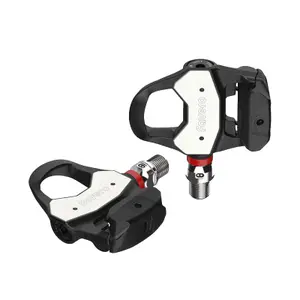


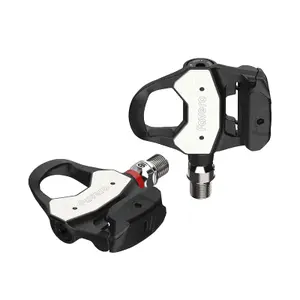
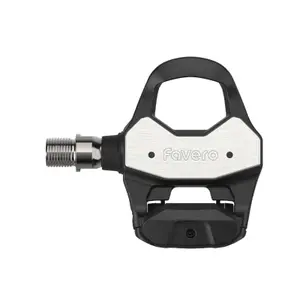


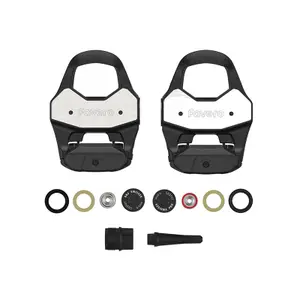


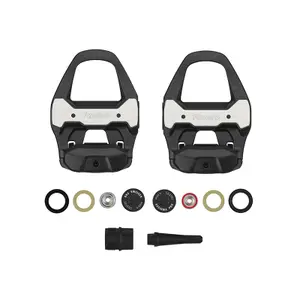


Clipless road bike pedals lock onto a three-bolt cleat fixed under a stiff-soled shoe: your foot stays in the same place with every revolution and the pressure is spread over a large area. Choose the system first, Keo, SPD-SL or Speedplay, then the cleat float and the release tension according to your experience. Some models also measure your power.
Why ride with clipless pedals on the road?
On the road, you turn the pedals thousands of times at a steady cadence. Locked onto the pedal, your foot never searches for its place and does not slip during a sprint or an out-of-the-saddle acceleration, and the single-sided pedal, wide and flat, takes the pressure of the stiff sole without creating pressure points. Shoe, cleat and pedal form a stable unit that limits foot fatigue over long distances. Releasing, by twisting the heel outwards, becomes a reflex after a few rides.
Keo, SPD-SL or Speedplay: which road system should you choose?
- Look Keo: a triangular three-bolt cleat engages from the front in a single-sided pedal. It is one of the most widespread systems on the road.
- Shimano SPD-SL: the same principle of a three-bolt cleat, with the brand's own system. The colour of the cleat indicates its float.
- Speedplay: the locking mechanism is housed in the cleat, and the very slim pedal engages on both sides on most models. Float is adjusted directly on the cleat.
Cleats from one system do not engage in another system's pedals: if you change pedal brand, plan for the matching cleats. Keo and SPD-SL fit standard road shoes, drilled with three holes.
Float, tension and cleat position: setting up your pedals properly
Float is the freedom of heel rotation before release. It lets the knee follow its natural path instead of forcing it into a fixed line. At Shimano, the red SPD-SL cleat is fixed, the blue one offers 2 degrees and the yellow one 6 degrees. Keo cleats come in fixed, 4.5 and 9-degree versions, and Speedplay cleats adjust from 0 to 15 degrees. If you are a beginner or your knees are sensitive, start with generous float.
Tension determines the effort needed to release. It is adjusted with a screw on most pedals; on Look's Keo Blade, an interchangeable carbon blade sets the stiffness. Set it as low as possible for your first rides. Finally, position the cleat so that the pedal axle sits under the joint of your big toe and angle it to the natural angle of your foot: a badly positioned cleat leads to knee or foot pain.
Road bike pedals with a power meter
Building the sensor into the pedal is the simplest way to measure your power: fitting takes a spanner, the sensor moves from one bike to another and the original chainset stays in place. Dual-sensor models measure each leg and the left-right balance; single-sensor models, less expensive, extrapolate the total from one side and can often be upgraded. Check the cleat system of the version you choose: some use Keo cleats, others SPD-SL or Speedplay cleats.
Gravel, touring, city: when should you prefer other pedals?
If you often walk during your rides, when touring or riding gravel, a two-bolt cleat recessed into a treaded sole is more practical: these systems are presented with the MTB pedals. For a bike also used in town, city bike pedals accept any shoe. All families, flat, dual-sided and power meter, are compared in bike pedals. After changing pedals or shoes, finally check the height of your road saddle again, as the thickness of the whole set-up can vary by a few millimetres.
Road bike pedal brands
Favero designs and makes its Assioma power meter pedals in Italy: the DUO, UNO and PRO RL use Look Keo cleats, the PRO RS are compatible with SPD-SL cleats, and all transmit via ANT+ and Bluetooth.
Shimano offers its SPD-SL system from the affordable RS500 to Ultegra and Dura-Ace pedals with a carbon composite body, and offers the PD-EH500, with one SPD side and one flat side, for touring cyclists.
Look, one of the historic names of the clipless pedal in France, offers the Keo Classic 3 with adjustable tension, the Keo 2 Max and the Keo Blade, whose carbon blade replaces the spring.
Wahoo took over Speedplay pedals: the double-sided Zero and Nano, the single-sided Aero, and the Powrlink Zero, which integrates a power meter.
Road bike pedals at reduced prices
End-of-line pedals and other road components move to road components clearance. New products arrive in new arrivals. For a complete system, pedals and shoes, keep an eye on Black Friday and the seasonal sales.
Frequently asked questions
How do you get started with clipless pedals?
Set the tension to the minimum, choose a cleat with float and practise clipping in and out while stationary, leaning against a wall. On the road, anticipate stops by releasing a foot well before the traffic lights or junction.
Can you use Look cleats on Shimano pedals?
No. The Keo and SPD-SL systems share the same three-bolt fixing on the shoe, but their cleats are shaped differently and only engage in their own pedals.
When should you change your cleats?
Road cleats wear mainly when you walk. Replace them when release becomes imprecise or happens on its own, when your foot develops play or when the wear indicators have disappeared. Mark their position before removing them so you can find the same set-up again.
What are hybrid pedals?
The term usually refers to dual-sided pedals, combining a cleat side and a flat side, or to two-bolt cleat pedals surrounded by a platform. On the road, they suit touring cyclists who also want to be able to ride in ordinary shoes.
Do you need a lot of float?
A few degrees of float suit most cyclists and are kind to the knees. A fixed cleat is aimed more at experienced riders whose position has been precisely set up, as it imposes the angle of the foot on every revolution.







