
Road cycling jersey for men and women


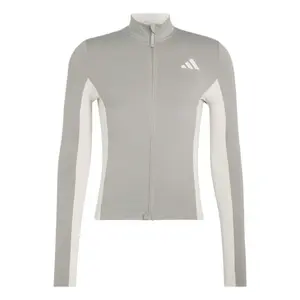


A road cycling jersey is worn close to the body: it wicks away sweat, offers less wind resistance than loose clothing and keeps your essentials within reach in its rear pockets. Choose the fit first, close-fitting for riding fast or more relaxed for long rides, then the sleeve length according to the temperature, and the fabric, synthetic or merino wool. Men's, women's and junior models are here, base layers included.
What is a road cycling jersey for?
A road jersey is the top designed for a cyclist's leaned-forward position. Its front zip regulates ventilation on climbs, its back, longer than the front, stays in place when your hands are on the hoods, and its rear pockets, usually three, carry bars, an inner tube or a windproof jacket without getting in the way of pedalling. Its technical fabric pushes sweat outwards and dries quickly, whereas a cotton T-shirt stays wet and chills your upper body from the first descent.
Race fit or relaxed fit: how should a cycling jersey fit?
Road jerseys fall into two main families. The close-fitting cut, known as race or aero fit, hugs the skin: the fabric does not flap in the wind, which matters as soon as the speed increases, in a group as well as solo. Its sleeves often extend further down the arm and its collar stays short. The comfort cut, sometimes called club or regular fit, leaves a little room at the stomach and shoulders: it suits long rides, cycle tourists and riders who dislike the feeling of compression.
For sizing, measure your chest and compare it with the brand's guide, as charts differ from one manufacturer to another. A well-chosen jersey does not wrinkle over the stomach in the riding position and does not ride up at the lower back. Women's models have their own cut, narrower at the shoulders and more shaped at the waist, and junior sizes fit young riders.
Which fabric for a cycling jersey?
Most jerseys combine a technical polyester with elastane, which provides stretch. Open mesh panels, on the sides or the back, speed up evaporation in hot weather. Merino wool, alone or blended with synthetic fibres, regulates temperature well and retains few odours: it is popular for long rides and cycle touring. For spring, autumn and winter, fabrics with a brushed inner face trap a layer of warm air while letting sweat through.
Other details matter day to day: a silicone gripper at the hem so the jersey does not ride up, a zipped pocket for keys, reflective inserts for rides at dusk, and UV protection on some summer jerseys.
Short sleeves, long sleeves or base layer: what to wear for the weather?
- In hot weather: a light short-sleeve jersey, possibly over a mesh base layer that draws sweat away from the skin.
- In spring and autumn: a short-sleeve jersey with arm warmers, easy to remove and slip into a pocket when the day warms up, or a thin long-sleeve jersey.
- In cold weather: a thermal base layer, a brushed long-sleeve jersey and, in rain or wind, a jacket on top.
The base layer is the first layer: worn directly against the skin, it transfers moisture to the jersey and keeps your torso dry. Choose it sleeveless or short-sleeved in summer, long-sleeved and thicker in winter. Arm warmers, leg warmers and headwear are in road clothing accessories, and the layers that stop wind and rain in road cycling jackets.
Completing your road cycling kit
The jersey works together with road bib shorts, whose chamois pad makes all the difference to comfort in the saddle: the bottom of the jersey should cover the waistband or bibs without compressing them. Road cycling gloves complete the outfit. If you ride mostly on trails, MTB jerseys have a looser cut and fabrics that are less prone to snagging. Helmets, shoes and rainwear complete the set in road cycling gear.
Which cycling jersey brand should you choose?
Isadore, a Slovak brand founded by the twins Martin and Peter Velits, both former professional riders, gives pride of place to merino wool, notably in its Signature and Debut jerseys.
Dare 2B offers the Lightning range, in short or long sleeves, with a cut designed for the riding position and reflective details to help you be seen.
Craft, born in Borås, a textile town in southern Sweden, made its name with technical underwear. Its jerseys range from the very light Pro Nano, in fine mesh for the heat, to the long-sleeved Core Bike SubZ models for the cold.
CMP, an Italian family company based near Bassano del Grappa and known for its outdoor clothing, offers cycling jerseys such as the Freebike.
Rogelli, founded in Dutch Brabant by former racer Rini Wagtmans, puts comfort ahead of fashion, with jerseys such as the long-sleeved Hero II or the Essential range.
Where can you find a cycling jersey on sale?
Jerseys from previous collections join road clothing clearance, and recently arrived models are gathered in new arrivals. To refresh your kit, also keep an eye on the seasonal sales and Black Friday.
Frequently asked questions
What is the difference between a cycling jersey and a sports T-shirt?
A cycling jersey has a longer back, rear pockets and a zip for ventilation, three features a sports T-shirt does not have. Its cut follows the cyclist's leaned-forward position and its fabric dries faster than cotton.
Should you wear a base layer in summer?
It is not essential, but an open-mesh base layer helps keep your skin dry when you sweat a lot and limits the feeling of cold on descents. It needs to be close-fitting to do its job.
How do you wash a cycling jersey?
Wash it at a low temperature, inside out with the zip closed, without fabric softener: softener clogs the fibres and reduces their ability to wick away sweat. Let it air-dry, away from a radiator. A merino jersey should be washed on a wool programme.
Long-sleeve jersey or arm warmers?
Arm warmers suit cool mornings that warm up: you remove them while riding or during a short stop. A long-sleeve jersey is more comfortable when the temperature stays low for the whole ride, as it leaves no cold gap between the sleeve and the arm.
Is a road cycling jersey suitable for gravel?
Yes, most road jerseys are suitable for gravel. For long self-supported rides, choose a model with roomy pockets, one of them zipped, and a tougher fabric if you ride through scrubland.







