
Cantilever brake pads, cyclo-cross and gravel


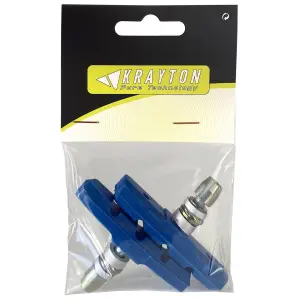
A cantilever brake pad is chosen based on how your brake is mounted, either a smooth pin secured in an eyelet or a threaded pin, then based on the rim, aluminium or carbon, and the conditions: a rubber that grips in the rain and mud makes a difference in cyclo-cross. Block pads, cartridges, and brake pad holders for cantilevers, V-Brakes, and road calipers are all gathered here.
Brake pads on a cyclo-cross or gravel bike?
Before disc brakes became common, cyclo-cross bikes used cantilever brakes, which are two-arm rim brakes pivoting on either side of the wheel, mounted on lugs welded to the frame and fork. Their design allows plenty of room for mud and wide tyres, which explains their longevity in rough terrains. They can still be found today on older cyclo-cross and touring bikes, on some entry-level gravel bikes, and on touring bikes, alongside mini V-Brakes. Their pads wear out quickly in the mud: these are the braking components that are most often replaced on these bikes.
Cantilever, V-Brake or caliper: which pad for which brake?
- Smooth stem cantilever: the pad has a cylindrical, non-threaded stem, secured in an eyelet crossed by a bolt. This setup allows for height, angle, and pinch adjustment with a single tightening.
- Threaded stem cantilever and V-Brake: the pad is fixed with a nut, along with contoured and hollow washers that allow for orientation. This is the setup for V-Brakes, mini V-Brakes, and many recent cantilevers.
- Road caliper: on a gravel or cyclo-cross bike equipped with calipers, the pads are road pads, either one-piece or cartridge-style in a pad holder.
Before ordering, check the stem of your current pad and note the length of the rubber. A cartridge only fits in a pad holder of the same type.
Braking in mud: rubber and rim
Mud and water mixed with sand turn the braking surface into sandpaper: the rubber wears away visibly and the rim gets worn away with it. For winter and cyclo-cross races, prefer a rubber that maintains grip on a wet rim, and check for wear after every wet ride. Use the tip of a screwdriver to remove the gravel lodged in the rubber: they can damage the rim. Cartridge pads change quicker, without needing to adjust again, which is an advantage when competing in multiple events. On a carbon rim, only use the pads recommended by the wheel manufacturer.
Adjusting cantilever pads
A poorly adjusted cantilever can rattle, screech, or lock the wheel. The entire surface of the pad presses against the rim, away from the tyre, and its front edge contacts a fraction of a second before its rear edge: this is the pinch. On a cantilever, the height of the cross cable, or the triangle that connects it to the main cable, also affects the power and feel at the lever. Road levers pull little cable: they work with cantilevers and mini V-Brakes, but not with long-arm MTB V-Brakes, which require a long-stroke lever. After adjusting, brake hard while stationary and check that nothing has shifted.
Cables, levers, and other braking components
A new pad won't fix a stuck cable: renew the gravel cables and housings at the same time, and check the lever among the gravel brake levers. To switch to disc brakes, see the gravel brake calipers and the gravel brake discs. Road bikes have their own road bike brake pads, while MTB V-Brakes have MTB brake pads.
What brands make cyclo-cross and gravel pads?
Shimano sells individual or boxed rubbers for its road calipers, like the R55C4 from the Dura-Ace and Ultegra generations and the R50T for the Tiagra and Sora, for gravel and cyclo-cross bikes equipped with calipers.
Sram offers replacement pads for Shorty cantilevers, designed for cyclo-cross, as well as pads and pad holders for its road calipers, including Red, Force, Rival, and Apex, plus pads for V-Brakes.
Clarks Cycle Systems has tri-compound pads, which combine three rubber mixtures, pad holders in Shimano, Sram, or Campagnolo formats, and pads for Weinmann brakes.
Brake pads on sale
Brake pads are among the consumables you buy in advance: watch for the road clearance sale, where cyclo-cross parts are also available, and look for recent items in the new arrivals. Before the cyclo-cross season, Black Friday allows you to build a small stock of pads.
Frequently asked questions
Cantilever or V-Brake: what's the difference?
Both attach to the same lugs, but the V-Brake has long vertical arms connected by a horizontal cable and requires a long-stroke MTB lever. The cantilever, being more compact, pulls less cable and works with road levers. The mini V-Brake, with short arms, bridges the two.
How to change a cantilever brake pad?
Loosen the bolt or nut of the pad, remove it while noting the order of the washers, then install the new one in the same position. Adjust height, angle, and pinch, tighten, and adjust cable tension at the lever. A cartridge is changed by removing its pin or locking screw.
When should a cyclo-cross pad be replaced?
As soon as the wear grooves of the rubber are nearly gone, when braking requires more effort, or when a metallic noise appears. After a muddy race, a pad can lose a significant amount of rubber in just one outing: check it every time.
Why does a cantilever brake rattle?
Most often due to insufficient pinch or because a fork flexes under braking. Apply a slight pinch to the front pads, check the tightness of the arms on their lugs, and clean the rim. A cable guide fixed to the fork or stem can also help mitigate the issue.
Can you switch from a cantilever brake to a disc brake?
Rarely: a cantilever bike generally lacks the caliper mounts on the frame and fork, as well as hubs for discs. Switching to disc brakes would then involve changing the frame, fork, and wheels; good pads and careful adjustment remain the simplest solution.







