
Cranksets and chainsets: single, double or triple


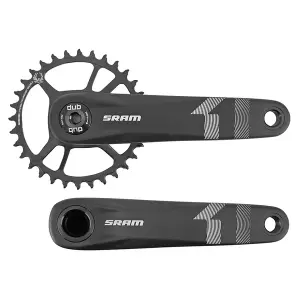


A crankset, or chainset, combines the crank arms, the chainring or chainrings and the axle that turns in the bottom bracket. To replace one, three points matter: an axle standard compatible with your frame's bottom bracket, the number of chainrings and speeds of your drivetrain, and the crank length. Road, MTB, gravel, city and BMX cranksets, axles and crankset parts are brought together here.
Single, double or triple chainring: which crankset for which riding?
- Single chainring: now the norm on performance mountain bikes and common on gravel bikes, it is paired with a very wide-range cassette; its alternating wide and narrow teeth hold the chain without a front derailleur.
- Double chainring: the benchmark on the road, as a 50/34 compact, a 52/36 semi-compact, or with lower gearing for gravel, such as 46/33.
- Triple chainring: for loaded touring, hybrid bikes and entry-level mountain bikes, with a small chainring that makes steep gradients easier, for example 48-38-28.
The number of teeth is chosen according to your terrain and your fitness: a small chainring makes climbs easier, a large one lets you go faster on the flat and downhill.
Axle and bottom bracket: understanding the standards
The crankset axle must match the bottom bracket housed in the frame. The main standards:
- Square taper axle: on city and entry-level bikes, each crank arm fits onto a four-sided axle; ISO and JIS tapers are not interchangeable.
- 24 mm axle: the Shimano Hollowtech II system integrates the axle into the drive-side crank arm, with bearings placed outside the bottom bracket shell.
- 28.99 mm DUB axle: the SRAM standard, which adapts to most frames through the choice of cups.
- 30 mm axle: for BB30, PF30 or BB386EVO bottom brackets, the latter with an 86.5 mm wide shell.
On the frame side, the bottom bracket shell is threaded, to the English BSA standard of 68 or 73 mm, the Italian standard or T47, or press-fit, in BB86, BB92, PF30 or BB386EVO. Note this standard on your frame or on the cups already fitted before choosing a crankset.
Crank length and chainline
Crank arms usually measure from 165 to 175 mm, in steps of 2.5 mm. Smaller riders and riders who pedal at a high cadence prefer short cranks, which also limit pedal strikes on a mountain bike. Always replace the pair at the same length. The chainline, the distance between the centre plane of the frame and the chainring, must match the frame: Boost mountain bikes require a chainring offset by about 3 mm outwards, and some downhill cranksets state their chainline in their name, such as CL55.
Chainrings, mounting and number of speeds
Chainrings are fixed to the spider of the drive-side crank arm, defined by its bolt circle diameter, such as 110 or 130 mm, or directly to the crank arm with direct mount. Their thickness and tooth profile depend on the number of speeds: a 12-speed crankset requires chainrings and a chain to the same standard. On entry-level cranksets, the chainrings and crank arm are sometimes riveted together: the whole unit is then replaced.
Power meter cranksets
Some cranksets incorporate a power meter, housed in the spider or the axle, which measures in watts the effort transmitted to the chainrings: this is the case with the SRAM Red, Force and Rival AXS in their power meter versions, or the Campagnolo Super Record Puissance. They communicate with a GPS bike computer and help you pace your training.
Creaking crankset or play: what should you check?
A creak with every pedal stroke often comes from insufficient tightening: crank bolts, chainring bolts, pedals or bottom bracket cups. Start by retightening to the specified torque and greasing the threads. Side-to-side play in the crank arm signals a preload adjustment to redo or worn bottom bracket bearings that need replacing. If the noise persists, it may also come from the saddle, the seatpost or the pedals.
Bottom brackets, chainrings and cranksets by discipline
A crankset is rarely fitted on its own: choose the bottom bracket that suits both the frame and the axle, and replace the chainrings or crank arms separately if needed. Power meters and pedals complete the set-up. For a selection by discipline, see our road cranksets, MTB cranksets and city bike cranksets.
Which crankset brands to choose?
Shimano has made its Hollowtech II system, a 24 mm axle fixed to the drive-side crank arm, the basis of its mid-range and high-end cranksets: Deore XT and SLX single chainring for MTB, Tiagra double for the road, GRX for gravel, Cues for leisure riding.
Stronglight, a component maker based in the Saint-Étienne area, offers the Impact as a 48-38-28 triple for touring and as a 48-34 double, with 165 or 170 mm crank arms.
SRAM has built its cranksets around the 28.99 mm DUB axle, compatible with many bottom brackets simply by changing the cups: Eagle single chainring for MTB, Red and Force AXS double for the road, sometimes with an integrated power meter.
FSA, for Full Speed Ahead, offers cranksets with a 30 mm axle for BB386EVO bottom brackets, such as the K-Force or the SL-K, as well as the Gossamer and, with a square taper axle, the Vero Pro.
SunRace, the Taiwanese manufacturer that owns Sturmey-Archer, offers aluminium MTB and city cranksets, such as the M9 or the MS954 triple, and a single chainring city crankset paired with Sturmey-Archer.
Campagnolo joins the two half-axles of its Ultra-Torque cranksets with a Hirth joint at the centre of the bottom bracket; here you will find the Super Record, Record and Chorus for the road and the Ekar for gravel.
Cranksets on sale: clearance and new arrivals
Cranksets from previous ranges move to our clearance crank and pedal parts, and the latest references join our new arrivals. Thinking of upgrading your drivetrain? Keep Black Friday and the seasonal sales in mind.
Frequently asked questions
How do you know which crankset fits your bike?
First identify the bottom bracket: its standard is often engraved on the cups; otherwise, measure the width of the shell and check whether it is threaded. Then note the number of speeds on the cassette, the number of chainrings and, on a mountain bike, whether it uses the Boost standard. The crankset must be compatible with all three.
What crank length do you need?
Most adults ride 170 or 172.5 mm cranks, taller riders 175 mm and smaller riders 165 mm or less. A crank that is too long tires the knees and slows your cadence, one that is too short reduces leverage. If in doubt, keep your bike's original length.
Can you switch from a triple to a double chainset?
Yes, provided you adapt the front derailleur and the shifter, which are designed for a given number of chainrings, and shorten the chain. Check that the cassette offers low enough gears for climbing to make up for losing the small chainring.
ISO or JIS square taper: what is the difference?
Both square tapers have the same angle but different dimensions: an ISO crank arm sits too far onto a JIS axle, and a JIS crank arm sits too high on an ISO axle. Shimano uses JIS, Campagnolo ISO; the axle designation tells you which.
Do new chainrings require a new chain?
Most often, yes: a stretched chain wears the chainrings, and a new chain skips on worn teeth. Measure chain stretch with a chain checker; if it is out of tolerance, replace the chain and cassette at the same time as the chainrings.







