
Rear derailleur for road, MTB and gravel


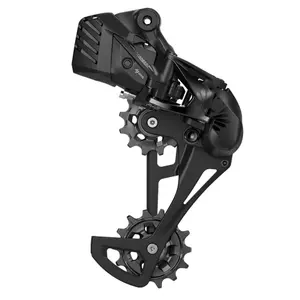


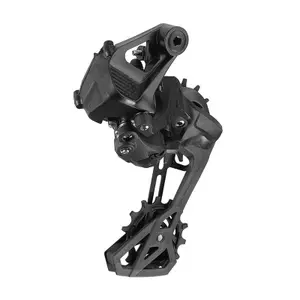
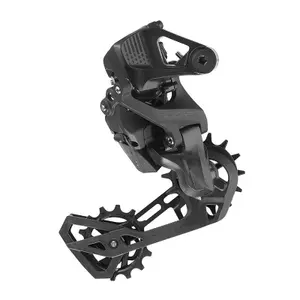

The rear derailleur moves the chain from one sprocket of the cassette to another and keeps it under tension. To replace it, start from your drivetrain: number of speeds, brand and family of the shifter, largest sprocket on the cassette, number of chainrings. Road, MTB and gravel models, from 6 to 13 speeds, mechanical or electronic, are gathered here.
How does a rear derailleur work?
The rear derailleur is fixed below the wheel axle, on the frame's hanger. A hinged parallelogram, pulled by the cable or driven by a motor, moves the cage sideways to line the chain up with the chosen sprocket; a spring brings it back when the cable slackens. The cage carries two jockey wheels: the upper one guides the chain, the lower one tensions it and takes up the length of chain released when you shift to a smaller sprocket. Two limit screws restrict the travel inwards and outwards, and a B-tension screw sets the gap between the upper jockey wheel and the sprockets.
Number of speeds, shifter and brand: compatibility first
A derailleur must match the number of speeds on the cassette and, above all, the shifter that pulls it: each click of the shifter releases a precise length of cable, which the derailleur translates into movement. This ratio differs from one brand to another and sometimes, within the same brand, between road and MTB or between two generations. The safest approach is to stay within the same component family as the shifter, or to check the manufacturer's compatibility charts.
Electronic derailleurs, such as Shimano Di2, SRAM AXS or Campagnolo WRL, are operated without a cable, by wire or wirelessly, and only work with the shifters of their own system. 6, 7 and 8-speed models mainly equip city and entry-level bikes, while 11, 12 and 13-speed models equip today's road bikes, gravel bikes and mountain bikes.
Short, medium or long cage: the capacity
The cage length determines the derailleur's capacity, in other words the difference in teeth it can absorb. It is calculated by adding the difference between the largest and smallest chainrings to the difference between the largest and smallest sprockets: a 50-34 chainset with an 11-34 cassette therefore needs a capacity of 39 teeth. The manufacturer also states the largest sprocket accepted. A short cage is enough on a road bike with a double chainset and a small cassette; a long cage is needed with a triple chainset or a very large cassette. At Shimano, the suffixes SS, GS and SGS designate these lengths.
Mounting and clutch: MTB, gravel or city
Most derailleurs bolt onto a derailleur hanger. Recent mountain bike and gravel frames adopt the UDH universal hanger, and SRAM T-Type derailleurs, with Full Mount fitting, clamp directly onto the frame of these bikes, without a hanger. At the other end of the scale, entry-level bikes without a hanger take derailleurs that bolt onto the wheel axle, sometimes supplied with an add-on hanger.
On a mountain bike or a gravel bike, choose a derailleur with a clutch: by slowing the movement of the cage, it stops the chain slapping against the frame or jumping off the chainring over bumps.
The parts that go with the derailleur
A bent derailleur has often bent its hanger: check it with drivetrain spare parts, which also offer cages. Jockey wheels can be changed without replacing the derailleur. On the shifting side, gear shifters must match the derailleur; a new bike chain and cassette often go with its replacement, and the front derailleur completes drivetrains with several chainrings.
Which rear derailleur brands?
Shimano covers every kind of riding, from the Tourney and Altus of entry-level bikes to the Deore and XT of mountain biking, by way of Cues, Sora, Tiagra, 105, Ultegra and GRX.
SRAM, the Chicago group, offers its 12-speed Eagle derailleurs, the T-Type with Full Mount fitting that does without a hanger, AXS models and the Apex XPLR.
Box Components, a BMX and MTB components brand, champions a simplified 9-speed drivetrain, its Prime 9 philosophy, and offers its One, Two and Three derailleurs, including a version for electric mountain bikes and a short-cage downhill model.
SunRace, a drivetrain maker associated with Sturmey-Archer, supplies many bike manufacturers; this page offers its 6 to 10-speed derailleurs, for a hanger or to bolt onto the axle.
Campagnolo, an Italian manufacturer, reserves its derailleurs for the road: Chorus, Record, Super Record WRL, in direct mount or UDH fitting, and 13-speed Super Record.
Microshift, the brand of the manufacturer AD-II Engineering, offers the Advent for 9-speed drivetrains and derailleurs compatible with Shimano shifters.
Rear derailleurs on sale
Derailleurs from previous generations, useful for like-for-like repairs, can be found in drivetrain clearance; new models are in new arrivals. Black Friday can also be a chance to move up a range.
Frequently asked questions
How do you adjust a rear derailleur?
First set the limit screws: the H screw aligns the jockey wheel with the smallest sprocket, the L screw with the largest. Then tension the cable on the small sprocket, and fine-tune the indexing with the barrel adjuster until every click shifts cleanly. Finish with the B-tension screw, which sets the gap between the jockey wheel and the large sprocket.
Can I fit an 11-speed derailleur to a 10-speed drivetrain?
Generally not: the cable pull ratio and the sprocket spacing differ, and the gears do not index correctly. A few exceptions exist within the same brand; check the manufacturer's compatibility chart.
What do SS, GS and SGS mean?
These Shimano suffixes designate the cage length: short, medium and long. The longer the cage, the greater the capacity, at the cost of a derailleur more exposed to impacts.
Does a road derailleur work with an MTB shifter?
Not always: depending on the generation, road and MTB do not use the same cable pull ratio. Preferably pair a shifter and a derailleur from the same family, or components stated as compatible with each other.
Why does my chain skip despite a new derailleur?
A bent hanger, a poorly tensioned cable, or a worn chain or cassette are the most frequent causes. Check the alignment of the hanger and the wear of the chain before adjusting again.







