
Front derailleur, double or triple chainset
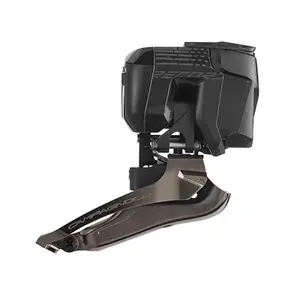


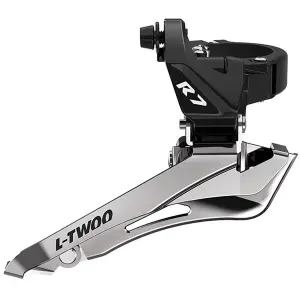
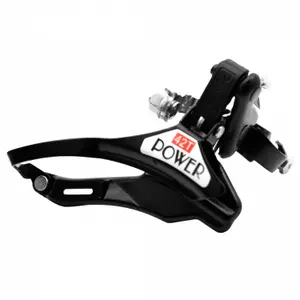
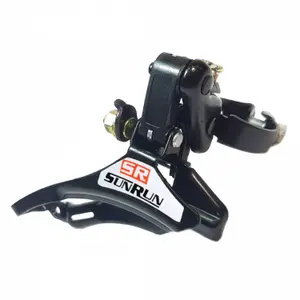
The front derailleur moves the chain from one chainring to another. To replace it, note four points: the number of chainrings and speeds, the mounting on the frame (clamp and its diameter, braze-on tab or direct mount), the direction the cable comes from and the kind of riding, road, gravel or MTB. Mechanical and electronic models are gathered on this page.
What does a front derailleur do?
Positioned on the seat tube, just above the chainrings, the front derailleur pushes the chain from one chainring to another with its cage, a metal guide through which the chain runs. It doubles or triples the number of gear ratios available: a large chainring for speed, a small one for climbs. On road bikes, the double chainset remains the rule; on mountain bikes, a single chainring has often replaced it, but many touring bikes, hybrids and leisure mountain bikes keep a double or triple chainset.
Double or triple chainset, road or MTB
The cage of a front derailleur is designed for a specific number of chainrings and a specific difference in teeth: a double model does not handle a triple properly, and vice versa. The manufacturer states the capacity, in other words the maximum difference between the large and small chainrings, as well as the large chainring size accepted. Road and MTB front derailleurs are not interchangeable: cage shape, cable pull and position differ. Finally, respect the number of rear speeds, because the width of the chain depends on it.
Clamp, braze-on or direct mount: the fitting
A clamp-on derailleur tightens around the seat tube: note its diameter, most often 28.6, 31.8 or 34.9 mm, some models being supplied with shims to adapt. The clamp can be high or low, depending on the space available above the bottom bracket. Road bikes mainly use the braze-on tab, a tab welded or riveted to the frame into which the derailleur bolts. Mountain bikes also use direct mounting on the frame or the E-type fitting, held by a plate trapped between the frame and the bottom bracket cup.
Cable pull, swing and electronic derailleurs
The cable arrives from above or below depending on the routing designed into the frame: a top pull, bottom pull or dual pull derailleur suits one or both. On mountain bikes, there is also top swing, down swing or side swing, as on Shimano's Side Swing models: choose the one the frame is designed for. Electronic derailleurs, Shimano Di2, SRAM AXS or Campagnolo EPS and WRL, change chainring at a simple press and correct their position by themselves; some are sold without a battery, to be ordered separately.
Other drivetrain parts
The front derailleur works together with the rear derailleur and the gear shifters, to be chosen from the same family. Cables, housing and small parts are in drivetrain spare parts; to overhaul the whole drivetrain, see the complete groupset and bike chains.
Which front derailleur brands?
Shimano offers the widest range on the page, from Tourney to Dura-Ace by way of Tiagra, Ultegra, GRX, Deore XT and XTR, including Side Swing and Di2 models.
SRAM offers braze-on Rival, Force and Red front derailleurs here, mechanical or electronic eTap AXS, for double chainsets.
Campagnolo, an Italian manufacturer, offers its road front derailleurs in Centaur, Chorus, Record and Super Record, in mechanical, electronic EPS or WRL versions.
SunRace, a drivetrain maker, offers low clamp, top and bottom pull derailleurs, supplied with adapters for 28.6, 31.8 and 34.9 mm tubes, up to 9-speed triple chainsets.
Front derailleurs on sale
Front derailleurs from past generations, valuable for like-for-like repairs, are waiting in drivetrain clearance; recent models are in new arrivals. Look out for the summer sales to restore a touring bike.
Frequently asked questions
How do you adjust a front derailleur?
Set the cage parallel to the chainrings, its outer edge 1 to 3 mm above the teeth of the large chainring. Set the low limit screw so that the chain does not fall off on the frame side, tension the cable, then set the high limit screw so that it does not jump off on the outside. Slight rubbing on the extreme sprockets can often be corrected with the shifter's trim.
What clamp diameter do I need for my front derailleur?
Measure the seat tube just above the bottom bracket: 28.6, 31.8 or 34.9 mm are the common values. A derailleur supplied with shims covers several diameters.
Does a double front derailleur work on a triple chainset?
No: its capacity and the shape of its cage do not cover the range of a triple. Choose a model stated for three chainrings.
How do I know if my front derailleur is top pull or bottom pull?
Follow the cable: if it comes down from the top tube, it is top pull; if it comes up from under the bottom bracket, it is bottom pull. Dual pull models accept both.
Can you switch from a double to a single chainring?
Yes, by removing the front derailleur and the left shifter, with a narrow-wide chainring and a rear derailleur able to handle a large cassette. You lose some gear ratios, but gain simplicity.







