
Derailleur jockey wheels, standard and ceramic




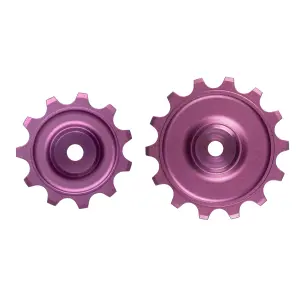


Derailleur jockey wheels guide and tension the chain under the cassette; when worn, they make the drivetrain noisy and imprecise. Choose them according to the exact model of your rear derailleur and the number of speeds: original Shimano, SRAM or Campagnolo jockey wheels, models on ball bearings or ceramic bearings, and oversized pulley systems to reduce friction.
What are jockey wheels for?
The rear derailleur carries two jockey wheels, the small toothed wheels mounted in its cage. The upper one, called the guide pulley, lines the chain up with the chosen sprocket; the lower one, called the tension pulley, takes up the slack in the chain when you change gear or when the suspension moves. They turn with every pedal stroke, often in mud and dust: their teeth wear and their axles develop play long before the rest of the derailleur.
How do you spot worn jockey wheels?
Pointed or hook-shaped teeth, clear lateral play, or a jockey wheel that catches or squeaks when you turn it by hand are signs that a replacement is needed. When riding, they show up as a grinding noise, chain skipping or less crisp gear changes. Check the jockey wheels every time you change the chain, and replace them as a pair: a new jockey wheel paired with a worn one only half solves the problem.
Bushing, bearing or ceramic: what are the differences?
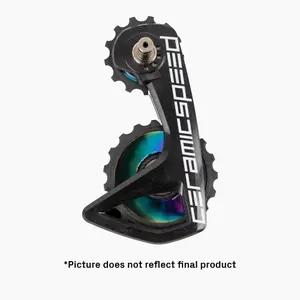
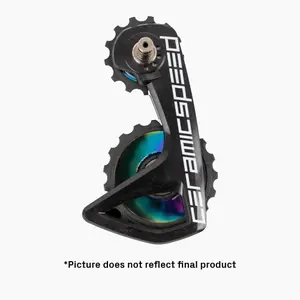
Entry-level jockey wheels turn on a simple bushing, inexpensive but more prone to wear. Jockey wheels on sealed ball bearings turn more freely and last longer. Hybrid ceramic bearings, with ceramic balls and steel races, reduce friction further, at the cost of careful maintenance to keep their advantage. Oversized systems replace the whole cage with a longer cage and large-diameter jockey wheels, of around 17 teeth: the chain wraps less tightly, which reduces friction.
Choosing compatible jockey wheels
A jockey wheel is chosen according to the derailleur model, engraved on its cage, and the number of speeds: the thickness of the teeth follows the width of the chain, which is thinner on 11 and 12-speed drivetrains. The number of teeth varies from 10 to 14 depending on the groupset, and the two jockey wheels on the same derailleur are sometimes different, in size as well as profile. On single-chainring drivetrains, alternating wide and narrow teeth hold the chain better. Respect the original position, upper and lower, and the direction of rotation when an arrow indicates it.
To replace them, undo the bolt of each jockey wheel with the right key, noting the order of the washers and covers, then refit the new jockey wheels in the same position. Tighten to the specified torque, with a little threadlocker if the manufacturer calls for it, and check that the chain runs cleanly between the cage plates. The indexing may need adjusting afterwards.
Other drivetrain parts
Jockey wheels wear along with the chain and the cassette: check your bike chain and cassette at the same time. If the cage is bent or the spring tired, a new rear derailleur is the answer; cages, hangers and small parts are gathered in drivetrain spare parts.
Which jockey wheel brands?
Shimano offers the original jockey wheels for its derailleurs, sold as a pair and named after the derailleur reference, from Deore to Dura-Ace by way of SLX, XT and Ultegra.
SRAM supplies the jockey wheels for its Eagle, Red eTap and GX derailleurs, often supplied with the inner cage plate.
Campagnolo, an Italian maker of road components, offers jockey wheel sets for its road derailleurs, including the 11-speed Super Record.
Elvedes, a Dutch supplier of workshop parts, offers jockey wheels on cartridge bearings supplied with their spacers, to suit many derailleurs, and kits dedicated to Shimano XTR, XT and SLX derailleurs.
CeramicSpeed, a Danish ceramic bearing specialist based in Holstebro, offers jockey wheels for Shimano, SRAM and Campagnolo, including the RS Alpha series, and replacement jockey wheels for its oversized systems.
Jockey wheels on sale
Jockey wheels from previous series are grouped in drivetrain clearance; new arrivals can be found in new arrivals. Black Friday is a good time to replace your chain and jockey wheels together.
Frequently asked questions
When should you change derailleur jockey wheels?
As soon as the teeth are pointed, the jockey wheel has play or it turns badly. A check every time you change the chain means you will not forget them.
Are ceramic jockey wheels worth it?
They turn more freely and last a long time if they are maintained. The gain remains modest for leisure riding; it mainly interests those looking for the lowest friction, in racing or on an already well-tuned drivetrain.
Are the upper and lower jockey wheels identical?
Not always: on many derailleurs, they differ in their number of teeth or their profile. Refit each jockey wheel in its original place and follow the direction of rotation if it is marked.
Can you fit jockey wheels from another brand?
Yes, if the jockey wheel is stated as compatible with your derailleur and your number of speeds: diameter, number of teeth, thickness and axle width must match.
Should you grease jockey wheels?
Clean them regularly to remove the mud and grease that build up between the teeth. Jockey wheels on sealed bearings do not need greasing from the outside; a drop of lubricant is enough on bushing jockey wheels.







