
Bike saddles for road, MTB, city and BMX


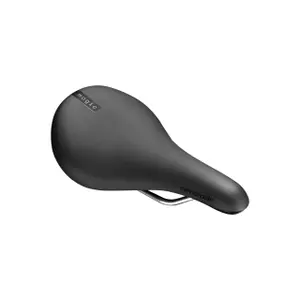
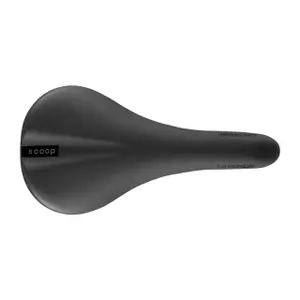
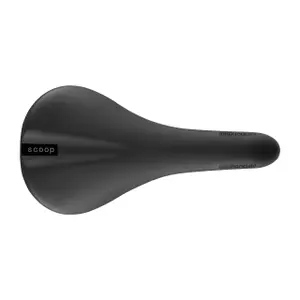


A comfortable bike saddle is first and foremost a saddle of the right width: it must support your sit bones, the pelvic bones that carry your weight when seated, without compressing soft tissue. Its shape then depends on your riding position, more or less leaned forward depending on your discipline. Road, MTB, city, triathlon and BMX saddles, seat clamps and front-mounted child seats are brought together here.
How do you choose your saddle width?
Everything starts with the distance between your sit bones. It can be measured in store on a pressure pad, or at home by sitting on a soft piece of foam that keeps the imprint of both bones: the distance between the centres of the two dips gives the measurement. The saddle should be a little wider than this distance, and wider still the more upright you ride. Sitting upright on a city bike, you rest entirely on your sit bones; leaning forward on a road bike, your pelvis tilts forward and a narrower saddle is enough. Many models come in two widths, such as the S and L sizes from Selle Italia or the narrow and wide versions from Selle San Marco.
Which saddle type for your riding?
- Road: a slim, firm saddle, long to vary your position or short for a very low position, such as the Selle Italia Boost versions or the Selle San Marco Shortfit.
- Triathlon and time trial: a noseless or open-nose saddle, which relieves pressure on the front of the pelvis in an aero position.
- MTB: a rounded profile to move easily behind the saddle on descents, reinforced edges against crashes, often a short rear.
- Dirt jump and slopestyle: a slim, low saddle with a grippy cover, to clamp between your legs during jumps.
- City and touring: a wider, more padded saddle, sometimes on springs, for an upright position.
- BMX: a slim, compact saddle that you rarely sit on.
Cut-out, padding, profile: the comfort points
A cut-out or central channel relieves pressure on the perineum, for women and men alike; at Selle Italia, Flow versions have a medium cut-out and Superflow versions a wide opening. The profile matters too: a flat saddle lets you move forward and back on the seat, while a curved saddle holds the pelvis in a precise spot. Thick padding is no guarantee of comfort: on a long ride, thick foam sags and presses on soft tissue, whereas a flexible shell and firm foam spread pressure better. Gel and springs still make sense for short trips in an upright position.
Rails and seat clamps: steel, titanium or carbon?
The rails connect the saddle to the seatpost and absorb some of the vibrations. Round, 7 mm in diameter, they are made of steel, manganese or chromoly steel, or titanium, which is lighter and more flexible. Carbon rails, often oval, require a compatible seatpost clamp and tightening to the specified torque. The page also brings together seat clamps: choose them by the outside diameter of your frame's seat tube, with a quick release if you adjust the height often, or with a bolt to deter theft.
Setting up your saddle: height, setback and tilt
A good saddle that is badly adjusted remains uncomfortable. For the height, put one pedal at the bottom of its stroke and place your heel on it: your leg should be straight. Once you hold the pedal normally, with the ball of your foot, there will be a slight bend at the knee. Start with a level seat, checked with a spirit level placed on the saddle, then adjust the setback by sliding the saddle along its rails, in small steps. Allow a few rides for each adjustment before drawing conclusions.
Front-mounted child seats: how do they work?
Front-mounted child seats attach to the frame of a mountain bike, between the adult and the handlebar: the child sees the trail ahead and stays between the parent's arms. Shotgun designs them for children aged 2 to 5 weighing 12 to 27 kg, with adjustable footrests on the Pro version. The child should always wear a properly fitted helmet.
Seatposts, stems and saddles by discipline
The saddle works together with its seatpost: seatposts are chosen according to the diameter of your frame's seat tube. To adjust the position of your upper body, see our stems and handlebars. MTB saddles and BMX saddles also have their own dedicated pages.
Which saddle brands to choose?
Chromag, a component brand born in Whistler, Canada, designed the Overture with rider Brandon Semenuk: a slim, grippy saddle for slopestyle and dirt jump, offered here in its Semenuk editions.
Selle Italia, the Italian saddle maker based in Casella d'Asolo and creator of the Flite, developed idmatch, a selection method based on the rider's measurements; its Boost versions are shorter and its Superflow cut-outs wider.
Repente, an Italian brand, attaches the saddle cover to its base with a removable system, the Repente Locking System, which lets you change it without taking the saddle off the bike; the page includes the Quasar and the Artax GL, designed for gravel.
Shotgun, the brand of Kids Ride Shotgun, designs front-mounted seats that let you take a young child on a mountain bike, including a Pro version with adjustable footrests.
ISM, an American manufacturer founded in Florida by a cyclist and swimmer, did away with the saddle nose in favour of two front prongs; the PN 3.0 and the PS 1.1 Triathlon use this design, adopted in triathlon and time trials.
Selle San Marco, the Italian saddle maker whose Rolls is an iconic model, also offers the Shortfit, a short saddle, and the Ground, derived from the Shortfit for gravel and MTB.
Where can you find a bike saddle on sale?
End-of-line saddles are in our bike parts clearance, and newly listed models in new arrivals. A well-chosen saddle also makes a gift idea for the festive season, and Black Friday is a chance to try a different shape.
Frequently asked questions
Do women need a specific saddle?
Not necessarily. Women's models often have a wider rear, a shorter nose and a central cut-out, because the distance between the sit bones is wider on average. But your measurement and your position matter more than the label: many unisex saddles come in several widths.
Why do I get numbness on the bike?
It points to excessive pressure on the perineum: a saddle too narrow for your sit bones, a nose tilted too far up, a saddle set too high or no cut-out. First check the tilt and the height, then consider a wider saddle or one with a central cut-out if the discomfort persists.
Do carbon rails fit every seatpost?
No. Their cross-section is often oval, for example 7x9 mm, and requires a clamp designed for this format; a clamp for round rails could crush them. Check your seatpost's specifications and tighten to the stated torque, without exceeding it.
From what age can a child ride on a front-mounted seat?
Shotgun recommends its front-mounted seats from 2 to 5 years, for a weight of 12 to 27 kg. The child must be able to sit unaided, rest their feet on the footrests and wear a helmet that fits. Start on easy trails, at a moderate speed.
How do you know if your bike saddle height is too high?
If your hips rock from side to side as you pedal, if you point your toes at the bottom of the stroke or if the back of your knee starts to hurt, the saddle is probably too high. A saddle that is too low, conversely, strains the front of the knee. Correct it in steps of a few millimetres.







