
Road bike derailleurs: front and rear


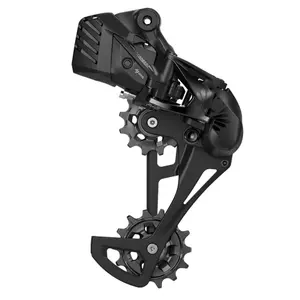


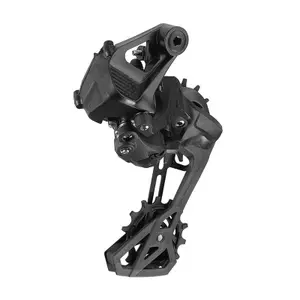
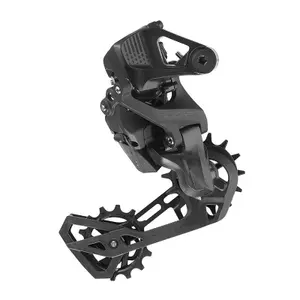
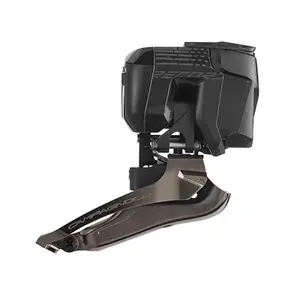



A road bike derailleur moves the chain from one sprocket or chainring to another on the shifter's command. At the rear, choose a cage long enough for the largest sprocket on your cassette; at the front, a braze-on or clamp-on mount depending on your frame. The number of speeds and the brand must match your shifters. Shimano, Sram and Campagnolo derailleurs, mechanical or electronic, are gathered here.
What do the derailleurs on a road bike do?
A road bike with a double chainset has two of them. The rear derailleur, fixed below the wheel axle, pushes the chain from one sprocket of the cassette to another, and its cage, fitted with two jockey wheels, keeps the chain under tension whatever combination you choose. The front derailleur, mounted on the seat tube above the chainset, moves the chain from one chainring to the other using a metal cage. On single-chainring drivetrains, common in gravel, the front derailleur disappears and the rear one does all the work.
Road bike rear derailleur: cage and capacity
The length of the cage determines the range of sprockets the rear derailleur can handle. A short cage follows a close-ratio cassette as closely as possible and shifts crisply; a medium or long cage absorbs the spread of a climbing cassette and the difference between two chainrings. Each derailleur states the largest sprocket it accepts: some show it in their name, such as a model limited to 28 or 32 teeth. For single-chainring gravel, long-cage derailleurs accept very wide cassettes. So before fitting a larger cassette, check this figure, or the cage may touch the sprockets.
Road bike front derailleur: braze-on or clamp-on
Two mounting types coexist. A braze-on derailleur bolts onto a tab fixed to the seat tube, the most common solution on current road frames. A clamp-on derailleur wraps around the seat tube: choose it according to the tube diameter, and an adapter clamp lets you fit a braze-on model to a frame without a tab. The front derailleur must also match the number of chainrings, double or triple, and the size of the big chainring: a cage designed for a double chainset cannot handle three chainrings.
Mechanical or electronic?
A mechanical derailleur is pulled by a cable from the shifter and returned by a spring: it can be adjusted and repaired with a few simple tools. An electronic derailleur carries a motor powered by a battery, either wired or built into the derailleur, and receives its orders from the shifter by cable or wirelessly. Its shifting stays consistent over time and can be fine-tuned from an app. An electronic derailleur only works with electronic shifters of the same brand and the same generation, and some are sold without a battery, for riders who already own one.
Compatibility, derailleur hanger and related parts
Shifter, cassette and derailleur form an inseparable trio, with the same number of speeds and the same cable pull: do not mix brands, nor always road and MTB ranges. The derailleur is fixed to a hanger, a deliberately fragile part that bends in a crash to protect the frame: a derailleur that rubs or skips gears after a knock often has a bent hanger. Some derailleurs mount directly on the frame or on a UDH universal derailleur hanger. To complete the replacement, see road bike shifters, cables and housing, on which the precision of a mechanical derailleur depends, and cassettes and chains. Gravel derailleurs and MTB derailleurs have their own pages.
Which road bike derailleur brands to choose?
Shimano offers its road derailleurs from Sora and Tiagra up to 105, Ultegra and Dura-Ace, in mechanical versions or Di2 electronic versions with E-Tube connectivity, plus its GRX models for gravel; the letters GS and SGS on some models indicate a medium or long cage.
Sram offers its Rival, Force and Red road derailleurs, mechanical or AXS wireless electronic, the latter sometimes sold without a battery, and long-cage XPLR versions for single-chainring gravel.
Campagnolo brings together here its Centaur and Chorus mechanical derailleurs, with braze-on or clamp-on front models, and its wireless Super Record WRL, available for direct mounting on the frame or for a UDH hanger.
Sunrace supplies 6 to 8-speed rear derailleurs, hanger-mounted or bolted onto the axle, to get a classic or entry-level road bike back on the road.
Microshift offers the Centos rear derailleur, compatible with Shimano 105 and Ultegra drivetrains according to its designation, and 8 and 9-speed models with a short or long cage.
Road bike derailleurs on sale
Derailleurs from previous generations, valuable for repairing a 9, 10 or 11-speed drivetrain like for like, join road drivetrain clearance. The latest road products are flagged in new arrivals. The winter sales, before the riding season starts again, are a good time for an overhaul.
Frequently asked questions
How do you adjust a road bike rear derailleur?
Adjustment is done in three stages: two limit screws restrict the derailleur's travel so that the chain falls neither between the cassette and the wheel nor off the smallest sprocket; cable tension, set with the barrel adjuster, lines up each click of the shifter with a sprocket; finally, the B-tension screw adjusts the distance between the upper jockey wheel and the cassette. Without experience, a workshop can adjust the whole thing in a few minutes.
Why does my derailleur skip gears?
Most often, the cause is a slack cable or dirty housing, a derailleur hanger bent in a crash, or a worn chain and cassette. Start by checking the cable tension and the alignment of the hanger before suspecting the derailleur itself.
Which cage should you choose for an 11-34 cassette?
A medium or long cage, depending on the model: check the largest sprocket accepted, as stated by the manufacturer. A short cage limited to 28 or 30 teeth will not cope with an 11-34 cassette, and the chain will often need lengthening.
Can you fit an MTB derailleur to a road bike?
Rarely without precautions: with several manufacturers, road and MTB derailleurs with the same number of speeds do not have the same cable pull and do not respond properly to road shifters. Some gravel ranges and some electronic groupsets allow these combinations: follow the manufacturer's compatibility charts.
Do you keep the front derailleur when switching to a single chainring?
No, switching to a single chainring does away with the front derailleur, and its shifter is then only used for braking. On the other hand, it requires a chainring that holds the chain securely, a wider cassette and a rear derailleur able to accept it. Road chainrings and complete groupsets make this conversion easier.







