
MTB brake levers: hydraulic and V-brake


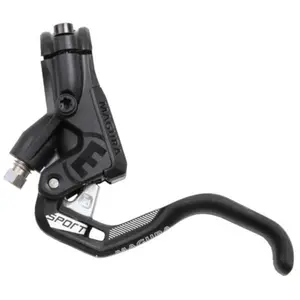
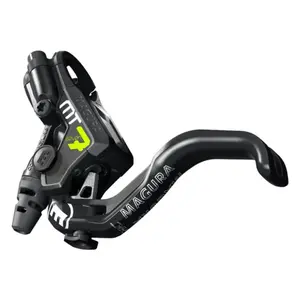


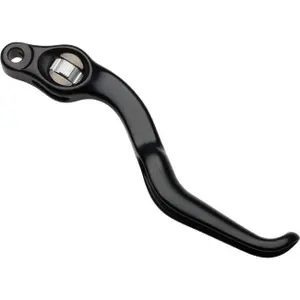

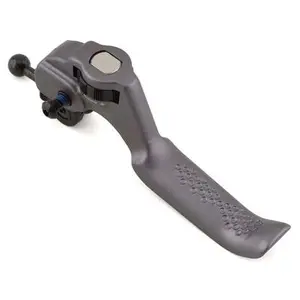


MTB brake levers control all of your braking power. On a hydraulic disc brake, the lever houses the master cylinder and is chosen with the calliper from the same range; on a V-brake, it pulls the cable with the travel this brake requires. Then adjust its reach to the size of your hands and its position on the handlebar. Complete levers, blades and internal spare parts are gathered here.
Hydraulic or mechanical lever: which one for your mountain bike?
The lever of a hydraulic disc brake contains a piston and a fluid reservoir: when you squeeze it, you push this fluid through the hose to the calliper pistons, which clamp the rotor. This system multiplies your effort and can be modulated with a fingertip, hence its dominance in mountain biking. Lever, hose and calliper form a closed circuit: a replacement lever must match the brake, and above all the fluid it contains.
A mechanical lever pulls a cable. It is the one used with V-brakes, cantilevers and mechanical disc brakes, common on entry-level mountain bikes and kids' bikes. V-brakes need long-pull levers, which pull more cable than a cantilever or road brake lever: paired with an unsuitable lever, they lack travel and brake poorly. A few hydraulic rim brakes complete the picture.
One, two or four fingers: the shape of the blade
A powerful hydraulic brake is operated with one or two fingers: the index finger alone is enough to slow down on a descent, while the other fingers hold the grip firmly. The short blades of these levers leave the rest of the hand free. A V-brake lever, with less leverage, often has a three or four-finger blade so you can apply more force. For children, a short-reach lever, designed for small hands, lets them brake without letting go of the handlebar.
Adjusting reach, bite point and position
Reach is the distance between the blade and the grip: a screw or a dial adjusts it so that the first joint of your finger rests at the end of the blade without stretching your hand. Some hydraulic levers add a bite point adjustment, which sets the moment when the pads touch the rotor. Then angle the levers so that they extend your forearms in riding position, standing on the pedals, and move them towards the grip to keep your index finger at the end of the blade. Several manufacturers offer clamps that combine the brake lever and the shifter on a single mount, for a cleaner handlebar.
Bleeding and servicing the hydraulic circuit
After replacing a lever or a hose, the circuit must be bled to remove the air, otherwise the lever becomes spongy. Each brake has its own bleed kit and fluid, indicated on the reservoir: DOT fluid or mineral oil, which must never be mixed, as the seals are designed for one or the other. DOT fluid absorbs moisture and is renewed regularly; mineral oil does not absorb any. A blade that returns slowly or a bite point that varies signals that servicing is due.
Callipers, pads and hoses
The lever works with MTB brake callipers and MTB brake pads, whose wear lengthens the travel of the blade. Hoses and cables are offered on the brake cables, outer casing and hoses page, and V-brake pads in MTB rim brake pads. For a drop handlebar, see road bike brake levers.
Which MTB brake lever brands should you choose?
Shimano covers the whole range, from the BL-T4000 V-brake lever to the XTR BL-M9120 hydraulic lever, by way of the Deore and SLX levers; BL-M9000 replacement levers are also available.
TRP, Tektro's sister brand, offers its mountain bike brakes with three levers: Slate Evo and Trail Evo for trail and enduro, and DH-R Evo for downhill, fitted to the bike of a World Cup winner.
Magura, founded in Bad Urach by Gustav Magenwirth, brought to market the first hydraulic rim brake, from which the HS11, HS22 and HS33 levers offered here descend, alongside the MT4, MT5 and MT7 levers of its disc brakes.
Sram offers its Level and Code levers here, as well as replacement blades and internals; on its recent brakes, a cam called SwingLink makes the power build up more progressively.
Hayes, an American group based in Mequon, Wisconsin, which makes brakes, suspension and wheels, offers the levers of its Dominion brakes, including the T series.
MTB brake levers on sale
Levers from updated ranges join MTB brakes clearance and recent products new arrivals. A key sales period such as Black Friday lets you upgrade to more powerful brakes before the season.
Frequently asked questions
Does a Shimano lever work with a calliper from another brand?
With a hydraulic brake, it is best avoided: fluid and seals differ from one brand to another, and each manufacturer designs its levers for its own callipers. With a mechanical brake, it is possible if the cable pull of the lever matches that of the brake.
Why is my brake lever spongy?
Air in the hydraulic circuit is the most common cause: a bleed solves the problem. Very worn pads, a rotor overheated after a long descent or a leak at the lever also produce a soft blade.
Do you need to bleed the brakes after changing a lever?
Yes, as soon as the circuit is opened. Some brakes are supplied ready to fit, with lever, hose and calliper already filled, but shortening the hose often means a bleed.
Can you replace just the lever blade?
On many models, yes: a blade bent in a crash can be changed on its own, without touching the circuit. Check the exact reference of the lever before ordering.
Which brake lever for a kids' mountain bike?
A short-reach or adjustable-reach lever that the child can reach without stretching their fingers. On a V-brake, keep a long-pull lever suited to this brake.







