
Front, rear and lowrider gravel bike racks


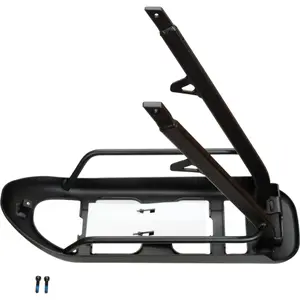


A gravel rack turns your bike into a travel mount, provided you respect its frame and fork. First, check the mounting eyelets and the manufacturer's specifications, then the clearance for disc brakes and wide tyres, wheel size, and the weight limit. The rear carries bags, while the front and lowrider help balance a heavily loaded bike.
Can your gravel bike accommodate a luggage rack?
The answer is found on the frame and in its manual. Many gravel bikes have threaded eyelets at the top of the seat stays and near the rear dropouts, sometimes also in the middle of the fork blades; others, especially among race-oriented carbon frames, have none, and their manufacturer may prohibit any luggage rack or limit the load. These guidelines take precedence over those of the luggage rack.
Without eyelets, there are three solutions: a rack mounted on the seat post, for just a few kilos; clamps tightened around the seat stays, reserved for metal frames; or a kit that relocates the lower attachment to the wheel axle. Beyond a day trip, a frame fitted with eyelets remains the most reliable base for carrying a load while travelling.
Disc brakes, thru-axles and wide tyres: compatibility
Three specific features of gravel bikes complicate the installation. The rear disc brake caliper occupies the space where the left leg of a traditional luggage rack descends: the model must be declared compatible with disc brakes, with the dropouts offset outward. The commonly used 12 mm thru-axle does not provide a quick release to hook the dropouts onto, which is why eyelets on the frame or fixings designed for this axle are beneficial.
Lastly, a tyre of 45 or 50 mm, possibly paired with a mudguard, requires sufficient clearance below the platform and between the support arms: each manufacturer specifies the maximum tyre width. Also take note of the wheel size, 700C or 650B, because an adjustable-height rack fits both, while a fixed model only suits one.
Rear, front or lowrider: where to place the load?
- At the back: the starting point of any trip. The rack holds a pair of panniers, a top bag or a bag secured on the platform.
- At the front, on the platform: a fork-mounted rack carries a bag or a small pouch above the wheel, handy for bulky but light items.
- As a lowrider: this lowered front rack suspends two panniers at hub height, lowering the centre of gravity and making a heavily loaded bike more stable than with all the weight at the back.
Every front rack requires a fork approved by its manufacturer and alters the steering behaviour: start light to get used to it before a long ride.
Aluminium, steel or titanium: which rack to choose?
Aluminium dominates, being lightweight and inexpensive, often in 6061 alloy on common models. Chrome-molybdenum steel, heavier, is valued by long-distance travellers for its robustness, while titanium offers the same slim tube design for significantly less weight. Whatever the material, it is the maximum load specified on the rack that counts; this results from tests conducted according to ISO 11243 standards, and this includes the load itself, bags included.
Bikepacking racks, which are very lightweight, often consist of a platform designed for a bag. They suit sport gravel bikes, while travel models, sturdier and equipped with side rails, accommodate fully loaded panniers on rough tracks. A lower rail that keeps the pannier away from the wheel prevents it from rubbing against it during bumps.
Panniers and luggage for your gravel bike
Once the rack is installed, it’s time to outfit it: gravel luggage rack panniers come in pairs or as a top version, with hooks that fit the diameter of its tubes. If your frame doesn’t support a luggage rack, saddle bags and frame bags take over without any threaded fixings, along with handlebar bags at the front. The gravel luggage encompasses all these categories.
Brands of luggage racks for gravel bikes
Racktime designs the Foldit 2.0, a rear luggage rack in aluminium, adjustable in height, with legs that fit wheels from 24 to 29 inches; it accommodates tyres up to 60 mm and receives luggage using the Snapit 2.0 system.
Tubus, a luggage rack manufacturer based in Münster, Germany, offers its Tara front rack in chrome-molybdenum steel, stainless steel, and titanium; the titanium version weighs about 330 g and requires a fork designated by the manufacturer to allow for a rack mount.
Zefal offers the Raider R70, a rear luggage rack compatible with disc brakes and wheels from 26 to 29 inches, as well as the Raider R30, which attaches to the seat post of a bike without eyelets.
Blackburn designed its Outpost front rack for travel: it holds a bag on each side of the wheel, and its upper platform is removable when you want a more discreet bike; it claims compatibility with wheels from 26 to 29 inches.
Discounted gravel luggage racks
The supports from previous collections join the road clearance, while the racks that arrive in the catalogue appear in the new arrivals. Don’t forget about the French Days or summer sales to equip your bike before a trip.
Frequently asked questions
Can a luggage rack be mounted on a carbon gravel bike?
Yes, if the frame has eyelets and its manufacturer allows it, within the weight limit they specify. Without eyelets, never use clamps on carbon stays: opt for a luggage rack on the seat post approved for your post, or bikepacking bags.
How to attach a luggage rack with a thru-axle?
The easiest way remains the eyelets on the frame, which the axle does not occupy. Otherwise, some manufacturers offer kits that mount with the axle and provide an anchor point for the rack's legs: they are specific to the length and thread pitch of the axle, which should be checked before purchase.
Is a seat post rack sufficient for gravel riding?
For a day trip with a top bag, yes. Its allowable load remains low, and it can pivot on the post over rough terrain: tighten it to the recommended torque, check it regularly, and save heavy loads for a rack bolted to the frame.
Is a front rack necessary for travelling on gravel?
It isn’t essential: a pair of rear panniers and a handlebar bag are enough for most lodge trips. The lowrider becomes useful when carrying a full load or over long distances, when the rear alone would be too heavy.
Are mudguards and a luggage rack compatible on a gravel bike?
Yes, provided there are enough eyelets or they can be shared, and enough space is left between the tyre and the platform. Check the maximum mudguard width specified by the manufacturer of the luggage rack, especially with tyres over 45 mm.







