
City bike and e-bike chainrings


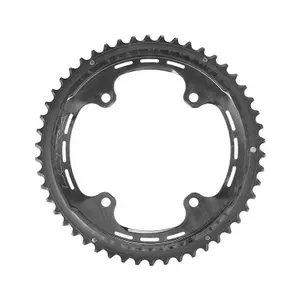


Replacing a chainring on a city bike or an e-bike calls for three checks: the fitting, on a four or five-arm spider or direct mount on the crank or the motor, the number of teeth and the number of speeds of the chain. E-bike chainrings for Bosch, Shimano or Yamaha motors, single and triple chainrings, chainring guards and road chainrings are gathered here.
What does the chainring do and when should you replace it?
The chainring drives the chain with every pedal stroke. Its number of teeth, together with the rear sprocket, sets the distance covered per turn of the pedals: a smaller chainring makes hills and loaded starts easier, a larger one lets you go faster at the same cadence. Over time, the teeth wear and take on a hooked or shark-fin shape: the chain then slips under load, especially when you accelerate. On an e-bike, the combined effort of rider and motor wears the drivetrain faster, and a stretched chain quickly damages a new chainring.
Fitting: number of arms, BCD and direct mount
A conventional chainring bolts onto the crank's spider with four or five bolts. The diameter of the circle passing through these bolts, called the BCD, must match exactly: 104 mm is common on mountain bikes and many e-bikes, 110 and 130 mm on road and all-round chainsets, 144 mm on track chainsets. A direct mount chainring, without a spider, fits onto the crank or the motor axle by splines, held by a lockring or bolts: each model is then only compatible with a specific system.
E-bike chainrings: motor, chainline and assistance
Each mid-motor requires its own chainring: Bosch, Shimano Steps, Yamaha, Brose, TQ and Fazua have their own interface, which sometimes changes from one generation to the next. There are often several offsets for the same interface, expressed as chainline, for example 52 or 55 mm: this figure lines the chainring up with the cassette and depends on the frame and the width of the rear hub. Note it on the original chainring or in the bike's specifications before ordering.
Changing the number of teeth alters the effort and the speed you get from each pedal stroke, not the motor's assistance limit. In the UK, an e-bike whose motor still assists above 15.5 mph no longer counts as an electrically assisted pedal cycle and is classed as a motorcycle or moped.
Single chainrings and narrow wide teeth
Without a front derailleur, a single chainring has to hold the chain on its own. Narrow wide teeth alternate a thick tooth and a thin tooth, which fit the wide and narrow chain links in turn: the chain comes off far less often on cobbles and kerbs. Some chainrings are machined from 7075 aluminium, harder than common alloys, to resist wear better.
Triple chainrings and chainring guards for the city
City and touring bikes with 7 or 8 speeds often have a triple chainring attached to the crank, which is replaced as a unit. The chainring guard, a plastic or metal disc fitted outside the large chainring, keeps your trousers away from the teeth and the grease; its size follows that of the chainring it surrounds.
Chain, chainset, derailleur: the parts linked to the chainring
A new chainring should be fitted with a chain in good condition: city bike cassettes and chains complete the job, and city bike chainsets replace the whole assembly when the chainrings are riveted. Changing a double or triple chainring also involves the derailleurs. For other kinds of riding, see road bike chainrings, MTB chainrings and all bike chainrings.
Which chainring brands should you choose?
E*Thirteen, a mountain bike component brand, devotes its e*spec line to e-bikes: direct mount chainrings for fourth-generation Bosch motors, the Shimano EP8, TQ HPR50 or Fazua Ride 60, and Helix chainrings.
XLC, one of the Accell group's parts brands, offers chainrings for Bosch motors, such as the CR-E40 with 34 to 38 teeth and a 52 or 55 mm chainline, as well as a chainring guard for 46 to 48 teeth.
Stronglight, a manufacturer from Saint-Étienne, offers chainrings for Bosch motors in 7075 aluminium with narrow wide teeth, alongside its track, gravel and road chainrings.
Prowheel, a Taiwanese chainset and chainring manufacturer, supplies triple chainrings for 7 or 8 speeds and a 40-tooth single chainring for single-speed bikes.
FSA offers e-bike chainrings, with a 104 mm BCD for fourth-generation Bosch motors, in Megatooth direct mount or for Yamaha motors, as well as Vero Pro and K-Force road chainrings.
Specialités T.A., a French manufacturer based in Sissonne, in the Aisne, designs and machines its chainrings in France, including e-bike models compatible with Bosch, Brose, Yamaha and Shimano.
Chainrings on sale and new arrivals
An end-of-line chainring often ends up in our city bike drivetrain clearance, alongside chains and cassettes; newly listed models can be found in new arrivals. The summer sales and Black Friday are good times for a complete drivetrain overhaul.
Frequently asked questions
How do you measure a chainring's BCD?
Measure the distance between the centres of two neighbouring bolt holes. On a four-arm chainring, multiply it by 1.414; on a five-arm chainring, by 1.701. The result gives the BCD, which is often also engraved on the chainring or the spider.
How do you know if a chainring is worn?
Look at the profile of the teeth: symmetrical and rounded when new, they become pointed and hollowed on one side with wear. A new chain that slips on the chainring confirms the diagnosis. The chainring wears more slowly than the chain: replace the chain in time to preserve it.
Does an e-bike chainring fit any motor?
No. The chainring depends on the make of the motor, its generation and the bike's chainline. A chainring designed for a fourth-generation Bosch motor will not fit a Shimano or Yamaha motor, and vice versa.
Can you fit a larger chainring on an e-bike?
Yes, within the limits of frame clearance and derailleur capacity, lengthening the chain if necessary. You will ride faster at the same cadence, without assistance beyond the limit set for your e-bike, and hill starts will take more effort.
What is an oval chainring for?
An oval chainring varies the gear over the course of the pedal stroke: larger when your legs push hardest, smaller through the dead spots, at the top and bottom. It gives a rounder pedalling feel; it fits like a round chainring, provided you respect its orientation.







