
MTB chainrings: single, double and triple


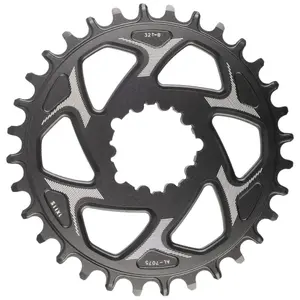


Choose an MTB chainring first according to your chainset: a four-arm fitting (104, 96 or 64 mm) or direct mounting on the crank arm, the number of speeds in your drivetrain, then the number of teeth to suit your terrain. Narrow-wide single chainrings for 1x, chainrings for doubles and triples, models for e-MTB motors: Shimano, Sram and the manufacturers that adapt to their cranks are all gathered here.
Single, double or triple chainring: which to choose for MTB?
On a modern mountain bike, the single chainring dominates: paired with a wide-range cassette, 10-51 teeth in Shimano 12-speed or 10-52 from Sram, it does away with the front derailleur and its shifter and makes the bike lighter. A double chainring keeps closer steps between gears, useful for trail touring. The triple chainring is still fitted to many 8 or 9-speed mountain bikes: there, you replace a worn chainring like for like, according to its position and number of speeds.
Four-arm or direct mount: the fitting to identify
A conventional chainring bolts onto the chainset's spider. Its bolt circle diameter, or BCD, is the diameter of the circle passing through the centre of the bolts; it is almost always engraved on the chainring. On mountain bikes, the most common value is 104 mm in four-arm, complemented by 64 mm for the small ring of a triple. Shimano used a 96 mm asymmetric four-arm fitting on several generations of Deore, SLX and XT, and Sram a 94 mm BCD on some chainsets.
Direct mounting fixes the chainring to the crank arm without a spider, with three bolts or a lockring depending on the system. It is not universal: a Sram direct mount chainring only fits a Sram crank, and a Cinch chainring only a Race Face crank, unless it is an aftermarket model designed for another interface. So note the exact reference of your chainset before ordering.
How many teeth for an MTB chainring?
Fewer teeth make the bike easier to push up steep climbs but you spin out sooner on the flat; more teeth do the opposite. On a single chainring, 32 teeth is the most common choice, 30 or 28 teeth suit mountains and enduro, and 34 or 36 teeth suit fast-rolling routes and quick cross-country.
On a direct mount chainring, also check the offset, that is, how far the chainring is shifted towards the frame. At Sram, the 3 mm offset corresponds to Boost frames and hubs in 148 mm, the 6 mm offset to older frames: getting it wrong shifts the chain line.
Narrow-wide teeth, speeds and e-MTB
A single chainring has no front derailleur to guide the chain: its teeth alternate between a thick and a thin profile, matched to the outer and inner chain links. Combined with a clutch rear derailleur, this narrow-wide profile limits chain drops in rock gardens. As the chain gets narrower with the number of speeds, a 12-speed chainring should be chosen for a 12-speed chain from the same family. Finally, oval chainrings give a longer gear during the power phase and a shorter one through the dead spots, improving traction on technical climbs.
On an e-MTB, the chainring fits an interface specific to the motor, Bosch or Yamaha for example, via a spider or direct mounting: choose a model designed for your motor and its generation. A bigger chainring changes the gear ratio, never the speed at which the assistance cuts out.
Other MTB drivetrain parts
MTB chainsets are needed if you change fitting standard or switch from a triple to a single chainring, in which case you will also need to check the capacity of your MTB derailleur. The rest of the parts are in MTB drivetrain. For a road or gravel bike, road chainrings and gravel chainrings are presented separately.
Which MTB chainring brands to choose?
Shimano, a Japanese manufacturer based in Sakai, near Osaka, gives its 12-speed direct mount chainrings, such as the Deore XT SM-CRM85, a Dynamic Chain Engagement+ tooth profile that keeps the chain in place on rough ground; they are joined by double chainrings for Deore, SLX and XTR.
FSA, a Taiwanese brand of the TH Industries group, cuts its Megatooth chainrings with long teeth, alternately thick and thin; several 104 mm models are designed for Bosch motors.
Specialités T.A. machines its chainrings in France, in Sissonne in the Aisne, from 7075 aluminium; its One range offers direct mount single chainrings for Shimano, Sram or Race Face cranks, and the Chinook range 104 mm chainrings for doubles and triples.
Stronglight, a manufacturer more than a century old from the Saint-Étienne area, forges and machines aluminium on site; its aftermarket MTB chainrings receive in-house surface treatments, CT2 or HT3, and the range includes single chainrings for Bosch and Yamaha motors.
Sram, an American group based in Chicago, claims to have invented the alternating wide and narrow tooth profile, which appeared on its X-Sync chainrings with its XX1 single-ring groupset; the 12-speed X-Sync Eagle chainrings come in a 3 or 6 mm offset, and in an oval version.
Race Face, born in Vancouver at the foot of the North Shore trails, designs its direct mount chainrings for the Cinch interface of its cranks, in versions for a Shimano 12-speed chain or for Bosch motors, as well as its 104 mm Narrow Wide single chainrings.
MTB chainrings on sale and new arrivals
End-of-line items join our MTB drivetrain clearance, while references that have just arrived are grouped in new arrivals. Between seasons, the winter sales and Black Friday are well timed for overhauling your drivetrain.
Frequently asked questions
Can you convert a mountain bike to a single chainring?
Yes, in general. You need a narrow-wide single chainring compatible with your chainset, often a wider-range cassette to keep climbing gears, a rear derailleur that can handle it and a chain shortened to the right length. The front shifter and derailleur are removed.
Do you need a chain guide on a single chainring?
In cross-country and trail riding, a narrow-wide chainring and a clutch derailleur are usually enough. In enduro and downhill, where the bike takes repeated impacts, a chain guide or a simple upper guide adds extra security and protects the chainring from rocks.
How do you know if an MTB chainring is worn?
Hollowed-out teeth shaped like a shark fin, pointed or hooked, are the most visible sign. Another symptom: a new chain that skips or creaks under load even though the cassette is in good condition. Replacing the chain before it stretches too much considerably extends the life of the chainring.
Will a Sram chainring fit a Shimano chainset?
With a 104 mm four-arm fitting, most chainrings fit whatever the make of the chainset, for the same number of speeds. With direct mounting, the interfaces differ: you need a chainring designed for your crank, which several independent manufacturers also offer.
Does an oval chainring need any special adjustment?
No, it fits like a round chainring, in the orientation indicated by the manufacturer. Allow a few rides to get used to the pedalling feel. On a double chainset, the front derailleur height is set according to the highest point of the oval chainring.







