
BMX grips: lock-on and flangeless


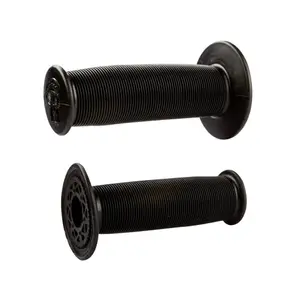
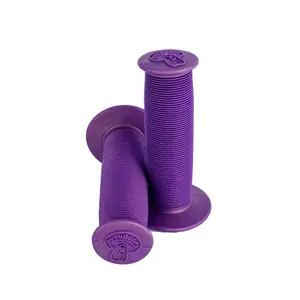
BMX grips are chosen on three criteria: the mounting, lock-on with clamped collars or push-on, whether there is a flange on the inner side, and the length, suited to the size of your hands. Race and freestyle grips, models for kids and bar end plugs are all on this page.
What do grips do on a BMX?
Grips give you a secure hold, absorb part of the vibration and close off the ends of the handlebar. Their compound, softer or firmer, their pattern and their diameter make a big difference to the feel: a soft compound grips and dampens more but wears faster, a firm compound lasts longer.
Lock-on or push-on BMX grips?
Lock-on grips are held by one or two collars clamped onto the bar: they do not twist, go on without glue and come off in a few seconds. Push-on grips, made from a single piece of rubber, are lighter and softer in the hand, but take a little technique to fit and are held in place by friction alone.
Flanged or flangeless grips?
The flange, the lip on the inner side, stops your hand sliding towards the stem and protects your fingers. Flangeless grips are popular in freestyle: they leave your hand free and do not get in the way of tricks where the bar spins. Many models come in both versions, such as the Odi Longneck.
Length, diameter and small hands
BMX grips fit 22.2 mm bar ends and their length varies from one model to another. Young riders are better off with shorter, thinner grips, such as models from 95 to 130 mm, so they can close their hand properly. A larger diameter suits big hands and filters out impacts better.
Bar end plugs: do not forget them
An open handlebar end can cause serious injury in a crash. Lock-on grips take end plugs, and plugs sold separately replace any that get lost. Check them every time you change your grips.
Parts to pair with your grips
Grips are often changed at the same time as the BMX handlebar or the stem. To look after all your contact points, see also pedals and BMX seats.
Which BMX grip brands to choose?
Odi, a manufacturer based in Riverside, California, that produces its grips in its own factory in the United States, claims to have invented the Lock-On system; its Longneck, in flanged and flangeless versions, sits alongside the Ruffian, the Hucker and the Rogue.
Position One, an entry-level BMX race brand that uses the geometry of Chase bikes, offers short grips of 95, 115 and 130 mm for the youngest riders.
Insight supplies racers with its C.O.G.S. grips.
Sensus, created by freeride rider Cam Zink to develop his ideal grip, the Swayze, also offers it in a flangeless version.
Salt Plus, the most advanced line of the Salt brand, founded in Cologne within the same group as Wethepeople, offers the Locked grips.
BMX grips on sale
End-of-line grips join BMX clearance, new colours appear in new arrivals. The winter sales are a good time to keep a spare pair in reserve.
Frequently asked questions
How do you fit push-on grips?
Clean the handlebar, then slide the grip on while blowing a little compressed air inside it, or use a fitting product designed for the purpose that then dries. Avoid grease and oil, which would let the grip twist.
How do you remove worn grips?
For lock-on grips, simply loosen the collars. For push-on grips, lift the edge with a thin screwdriver and inject a little air or soapy water, or cut them off with a craft knife if they are ready for the bin, without scratching the bar.
Flanged or flangeless for a beginner?
On the track and when you are starting out, a flange is reassuring because it keeps your hand in place. If you are working on tricks where the bar spins, a flangeless grip becomes more practical.
What grip length for a child?
Choose a short, thin grip, around 95 to 115 mm, so that the child can close their hand properly and reach the brake lever easily.
Do BMX grips fit a mountain bike?
Yes, MTB handlebar ends are also 22.2 mm. Just check that there is still room for the brake levers and gear shifters, as BMX grips are often longer.







