
BMX stems for race, freestyle and mini


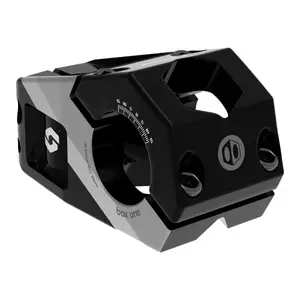


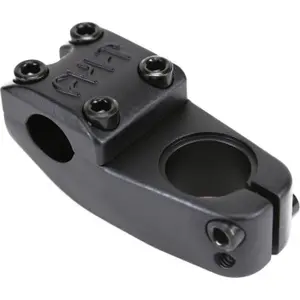


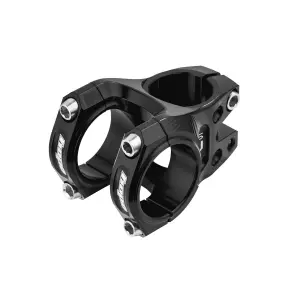
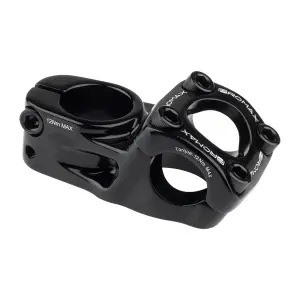
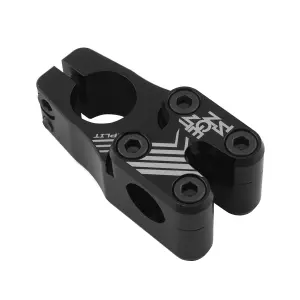


A BMX stem connects the handlebar to the fork steerer and sets the position of your hands. Choose it by its bar clamp, usually 22.2 mm, or 31.8 mm on some race bikes, then by its mounting, top load or front load, and finally by its length. Race, freestyle, mini and junior stems, and their replacement bolts, are all on this page.
What does the stem do on a BMX?
On a BMX, the stem clamps onto the fork's 1 1/8-inch steerer and holds the handlebar. Its length, measured from the centre of the steerer to the centre of the bar, and its height determine where your hands sit. A short stem makes the steering quicker, which street riders look for; a slightly longer stem moves your hands forward and keeps the bike stable at high speed.
Top load or front load BMX stem?
A top load stem clamps the bar with a cap bolted on top: it is the most widespread design, compact and easy to adjust. A front load stem clamps it with a faceplate at the front, like the Cult Mind Control or the Wethepeople Index Frontload: the bar sits further forward and its height changes. With the same bar, switching from one to the other changes your position.
BMX stem clamp size: 22.2 or 31.8 mm
The vast majority of BMX bars clamp at 22.2 mm. A few race bars move up to the stiffer 31.8 mm and need an oversized stem, such as the Elevn OS in 31.8 mm. Check this measurement, engraved on the stem and on the bar, before you order.
Mini and junior stems
Young riders have shorter arms: mini and junior stems, such as the Insight Mini/Junior or the kids' version of the Pride Racing FTL, bring the bar closer to them. Pair them with a bar whose height suits the frame size.
How to fit and tighten a BMX stem
First adjust the headset with the top bolt, then line the stem up with the front wheel and tighten its steerer bolts. Next tighten the bar clamp bolts in a cross pattern, gradually, to keep an even gap, up to the torque engraved on the part. Check the bolts again after your first sessions.
Parts to pair with your stem
Choose your stem together with the BMX handlebar it holds and the BMX fork it clamps onto. For a mountain bike or a road bike, see MTB stems, road bike stems and the full range of bike stems.
Which BMX stem brands to choose?
Pride Racing, a BMX race brand that designs its parts in France, offers the Cayman V2 and the FTL, which also comes in a kids' version.
Elevn makes OS stems for 31.8 mm bars and CNC-machined Pro models for racing.
Insight caters for small riders with its Mini/Junior stem and for experienced racers with the Pro.
Box, born out of racing in California, supplies aluminium top load stems, the Box One and the Box Two Top Load Pro.
Cult reserves for freestyle its forged Salvation, available in several versions, the Redemption and the front load Mind Control.
Wethepeople offers the front load Index, the Hydra, the Patrol and a signature stem for Kira Keiryo Kudo.
BMX stems on sale
End-of-line stems move to BMX clearance, recent references to new arrivals. Black Friday and the seasonal sales are a good chance to try a different length.
Frequently asked questions
Top load or front load: which should you choose?
Top load is the most common, light and easy to adjust. Front load positions the bar differently and appeals to some street riders. With the same bar, your position changes: try one before you adopt it.
What stem length for a BMX?
It depends on the rider's size, the frame and the discipline. Street riders favour short stems for quick steering; in racing, the length follows the size of the bike, shorter on mini sizes, longer on pro sizes.
Does a BMX stem fit a mountain bike?
The 1 1/8-inch steerer is common to both, but MTB handlebars usually clamp at 31.8 or 35 mm, against 22.2 mm on a BMX. Apart from special cases, a BMX stem is therefore not suited to a mountain bike.
How do you line up the stem with the front wheel?
Stand over the bike with the wheel between your legs and line up the bar so that it is perpendicular to the wheel. Tighten lightly, check again after riding a few metres, then tighten to the specified torque.
Can you add spacers under the stem?
Yes, within the limit of the steerer length: spacers raise the bar by a few millimetres. The stem must always clamp the steerer over its full height.







