
Bike disc brake rotors: 6-bolt and Center Lock


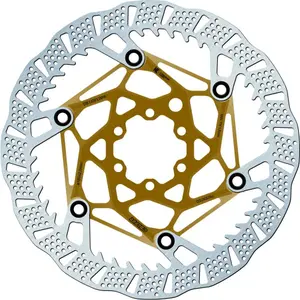


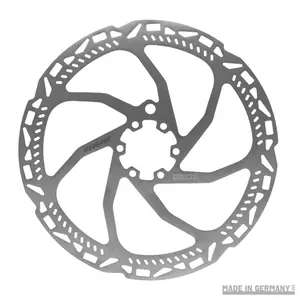
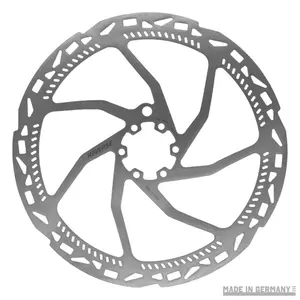


Bike brake rotors are chosen on three criteria: your hub's mounting, 6-bolt or Center Lock, the diameter allowed by your frame, fork and calliper, from 140 to 220 mm, and the type of pads the rotor accepts. Replace a rotor when it falls below its minimum thickness, when it is warped or after overheating.
What does the rotor do and how does it wear?
The rotor is the surface the pads clamp onto: it turns the bike's momentum into heat and has to dissipate it quickly. It wears at the same pace as the pads, faster with a sintered metal compound, in the rain or in mud. Its thickness decreases, grooves form, and a thinner rotor heats up more and warps more easily.
6-bolt or Center Lock: which mounting for your hub?
Shimano distinguishes two mountings. A 6-bolt rotor is bolted to the hub with six bolts, most often with a Torx T25 head. Shimano's Center Lock fits the rotor onto a splined hub and holds it in place with a lockring, for quick fitting. The lockring is tightened with a cassette tool when its splines are internal, or with a bottom bracket tool when they are external; both versions are on this page. An adaptor lets you fit a 6-bolt rotor to a Center Lock hub.
Which rotor size should you choose?
The larger the rotor, the further from the axle the pads clamp: braking gains power and the heat is spread over a larger surface. On the road and for gravel, 140 and 160 mm are the most common, with Shimano keeping 140 mm for the rear; on mountain bikes, 180 and 203 mm dominate, and 220 mm is fitted to some downhill bikes and heavy e-bikes. According to Shimano, a 220 mm rotor brakes around a tenth harder than a 203 mm one. The maximum diameter is set by the frame and fork; to move up to a larger rotor, an adaptor moves the calliper away from the hub.
Thickness, construction and compatibility
A standard Shimano rotor is 1.75 mm thick when new, and the brand says it should be replaced at 1.5 mm, or as soon as the aluminium core becomes visible. Other, thicker rotors handle heat better in aggressive mountain biking. The minimum thickness is often engraved on the rotor; at Galfer, it is 0.5 mm below the original thickness. Measure it with a vernier calliper on the braking surface, not on the edge.
In terms of construction, one-piece stainless steel rotors sit alongside two-piece rotors, whose steel braking track is riveted to a lighter aluminium carrier, and sandwich rotors in steel, aluminium and steel, which dissipate heat better. Before fitting metal pads, check that the rotor accepts them: several Shimano rotors are for resin pads only.
Pads, adaptors and complete brakes
A new rotor and new pads go hand in hand: see the disc brake pads compatible with your calliper. Adaptors for changing diameter and bleed kits are in bike brake parts, and complete brakes among disc brakes and brake callipers. All bike brakes and parts are gathered on one page.
Which brake rotor brands should you choose?
Shimano fits its RT-CL800 and RT-CL900 rotors with Ice Technologies Freeza: an aluminium core sandwiched between two layers of steel and radiator-style fins, which limit warping during prolonged braking.
Galfer, a Spanish manufacturer from Granollers, has patented the wavy braking track of its Wave rotors, recommended for mud and wet conditions; the two-piece Shark Evo is aimed at enduro, downhill and e-bikes.
Brake Authority, a French brand founded by downhill racer Fabien Barel and Frédéric Glo, cuts its Burly and Aggressive rotors from 1.8 mm stainless steel; the Aggressive, semi-floating with three rivets, is designed for racing.
Sram offers the CenterLine, quiet and with rounded edges, for both road and MTB, in 6-bolt or Center Lock, and the 2 mm thick HS2, designed for mountain biking.
Hayes, an American manufacturer from Wisconsin, designed its D-Series rotors for its Dominion brakes: 1.95 mm thick, with cut-outs that reduce noise and vibration.
Brake rotors on sale
End-of-line rotors and less popular diameters end up in our brake clearance; new generations of rotors are presented in new arrivals. Black Friday is a chance to get a spare pair of rotors and pads in advance.
Frequently asked questions
When should you replace a brake rotor?
When it reaches the minimum thickness engraved on its surface or given by the manufacturer, or when it shows a crack, a warp that can no longer be corrected or a deeply grooved braking surface. A rotor contaminated with oil can be cleaned, but the pads that rubbed on it need replacing.
Should you change the pads at the same time as the rotor?
It is advisable: worn pads have taken the shape of the old rotor and do not bear properly on a new braking surface. Fit a new rotor and new pads together, then bed them in with a series of progressive stops before riding normally.
160 or 180 mm rotor at the front?
160 mm is enough on the road, for gravel and on a light mountain bike; 180 mm brings more power and better heat resistance, useful in the mountains, for a heavier rider or on an e-bike. The front, which does most of the braking, often takes a larger rotor than the rear, within the limit allowed by the fork.
How do you true a warped rotor?
A slight warp can be corrected with a rotor truing tool that levers the braking surface, after spotting the point that rubs with the wheel spinning. Make small corrections, with clean hands so as not to contaminate the braking surface. A clearly bent rotor, or one that still rubs after correction, should be replaced.
Why does a rotor change colour?
Blue or brown tints are a sign of severe overheating, common on long descents with the brakes held on. Check for warping and inspect the pads, which may have glazed. If it happens again, a larger rotor or one with cooling fins will dissipate heat better.







