
Bike disc brakes: hydraulic or mechanical


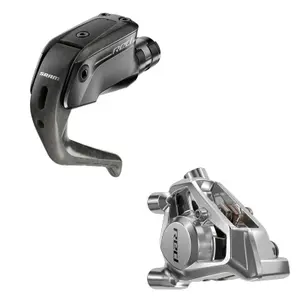


Bike disc brakes are chosen according to the bike they have to stop: two pistons are enough for cross-country, road and city riding, while four pistons suit enduro, downhill and e-bikes. Then check the calliper mount on your frame, the fluid required by the brand and whether or not the rotor is included. Hydraulic, mechanical and semi-hydraulic brakes, front or rear, are all brought together here.
What does a complete disc brake contain?
A disc brake includes four elements: the lever fixed to the handlebars, the transfer of force by cable or through a hose filled with liquid, the caliper bolted to the frame or fork, and the disc screwed onto the hub, which the pads grip. The brakes on this page are sold with the wheel, either front or rear, or in pairs. The hose for a rear brake is longer, as it runs down to the bottom of the frame. Depending on the model, the disc and adapter are either included or need to be ordered separately: the product title often specifies this with mentions of “with disc” or “without disc or adapter”.
This type of brake is now used on most mountain bikes, gravel bikes, and electric bikes, as well as many road bikes. It maintains the same efficiency in the rain, mud, or during long descents, a decisive advantage on a heavy or loaded bike.
Cable or liquid: three ways to transfer braking
In a hydraulic brake, the lever compresses a liquid that activates the pistons in the caliper. The system multiplies the effort from the hand: one or two fingers are enough to brake hard, and the pistons automatically adjust for the wear of the pads. This is the reference solution for mountain biking and electric-assisted bikes.
The mechanical brake is controlled by a cable, like a rim brake. It accommodates existing cable levers, is adjusted with a simple wrench, and can be repaired without bleeding tools, making it a sensible choice for long journeys or regular-use bikes. The pads are adjusted manually as they wear.
The semi-hydraulic brake uses a cable up to the caliper, which contains its own small hydraulic circuit. It allows for the use of cable levers while benefiting from some of the power and comfort of hydraulics.
Two or four pistons: what power for which bike?
A hydraulic caliper can have two pistons, one on each side of the disc, or four, two on each side. With four pistons, the pad is longer, the clamping force increases, and heat is distributed better, for a little more weight. Here are some guidelines:
- Cross-country, road, gravel, and city: two pistons and discs from 140 to 180 mm.
- Trail and all-mountain: two or four pistons, with at least 180 mm at the front.
- Enduro, downhill, and electric mountain bike: four pistons and discs from 200 to 220 mm, to handle long descents without losing efficiency.
- Urban electric bike and cargo bike: a hydraulic brake that the manufacturer designs for these heavy bikes, with larger diameter discs.
Mounting, liquid, collar: compatibility to check
The caliper is mounted according to the standard set by the frame and fork: Post Mount, the most common in mountain biking, Flat Mount, the flat caliper for road and gravel bikes, or IS, an older standard that can be converted with an adapter. An adapter is also used to switch to a larger disc, within the limits set by the manufacturer of the frame and fork.
The liquid is determined by the brake brand. Shimano, Magura, Tektro, and the Cura family from Formula use mineral oil, like the Maven from Sram, while most other Sram brakes operate with DOT liquid. Never pour one in place of the other: the seals in each system can only handle their own liquid. At the handlebars, the I-Spec collars from Shimano and MatchMaker from Sram attach the gear shifter to the brake lever, as long as they stay within the same family. Finally, a hose cut to the length of the bike often requires bleeding.
Discs, pads, levers: replacing just one part
When only one part wears out, there's no need to change the whole brake. The brake discs and pads can be selected based on the caliper reference. A broken lever can be replaced from the brake levers, and a damaged caliper from the brake calipers. Hoses, adapters, and bleed kits await in the brake spare parts; the entire bike braking system also includes rim brakes.
Which brand of disc brake for your bike?
Clarks Cycle Systems, an English manufacturer of braking parts based in Derby, aims to equip everyday bikes: its hydraulic brakes M2 and Clout 1, with two pistons and mineral oil, are offered here with their disc, including a Post Mount version.
Sram covers mountain biking with four hydraulic families: Level, with two pistons for cross-country and trail, G2, an heir of the Guide, for trail, Code for enduro, and Maven, its most powerful brake, with four pistons and mineral oil, designed for downhill, enduro, and electric mountain biking.
Shimano offers its mountain bike brakes from Deore to XTR, including SLX and XT, whose Servo Wave lever quickly brings the pads closer to the disc to allow more travel for modulation. The Saint is its downhill range, and the I-Spec EV collar directly accommodates the gear shifter.
Tektro, a manufacturer specializing in braking systems, offers its Orion with four pistons: the HD-M750 version is designed for electric mountain bikes with central motors and for thicker discs, at 2.3 mm.
Formula, an Italian brand, gathers its mineral oil brakes in the Cura family: the two-piston Cura for light use, and the Cura 4, with four 18 mm pistons, for enduro and downhill.
Magura, a family company from Bad Urach, Germany, a pioneer of hydraulic rim brakes, equips its MT brakes with a Carbotecture lever, a lightweight composite: MT5 with four pistons for serious mountain biking, MT4 with two pistons, also available in MT4 eSTOP for electric bikes.
Discounted disc brakes and new products
When a range changes generation or finish, its brakes go into the braking clearance sale: it’s the perfect time to equip a second bike. Newly listed models can be found in the new arrivals, and summer sales such as the French Days are great opportunities to upgrade your braking system.
Frequently Asked Questions
How does a bike disc brake work?
By pulling the lever, you either pull a cable or push a liquid to the caliper. Its pistons then press two pads against the disc attached to the hub, and the friction turns speed into heat. Positioned at the centre of the wheel, far from splashes that can dirty the rim, the disc maintains its efficiency in the rain.
Why is my disc brake not working anymore?
The most common causes are pads worn down to the backing, pads contaminated with oil or chain lubricant, or air in a hydraulic circuit, which makes the lever spongy. First, check the thickness of the pads, then the lever's travel. Soiled pads should be replaced, while a spongy lever requires bleeding.
Which disc brake to choose for an electric bike?
The weight of the bike and sustained cruising speed demand more from the braking system. A hydraulic brake, preferably with four pistons on an electric mountain bike, combined with discs of 180 to 203 mm, provides the necessary power reserve. Some models are designed for these bikes and accept thicker discs.
Can you fit a disc brake on a bike with rim brakes?
This requires mounting brackets for the caliper on the frame and fork, as well as hubs designed to accommodate a disc. Without these fittings, safe installation is not possible. In that case, a high-quality rim brake or new pads remains the best option.
Is the disc included with the brake?
This depends on the model. Some kits are complete, including the disc and adapter, while others are sold without a disc so you can choose the diameter and fitting, 6 holes or Center Lock, suited to your wheels. The title and description of each product indicate this.







