
MTB dropper posts and seatposts, 30.9 to 34.9
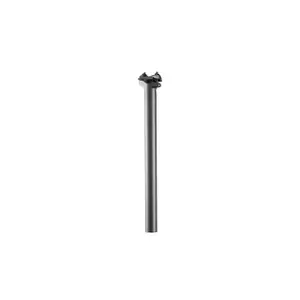


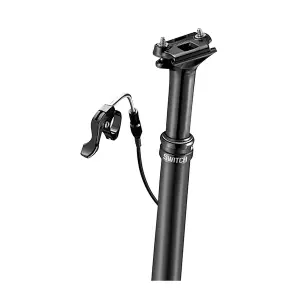

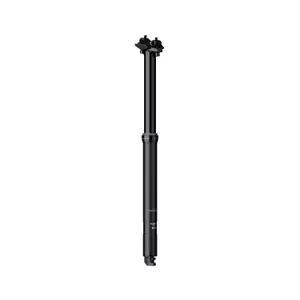


An MTB dropper post lowers the saddle at the push of a lever on the handlebar to clear the way on descents, then raises it again for pedalling. Its travel is chosen according to your height and the insertion depth of the frame, its diameter according to the seat tube. Rigid posts for cross-country, suspension seatposts for hardtails and service parts complete the page.
Why has the dropper post become standard on mountain bikes?
On a descent, a saddle left at pedalling height blocks your pelvis when you want to move back and get low. Lowered, it frees up that space, lowers your centre of gravity and lets the bike move beneath you. On climbs, the saddle returns to full height and your pedalling regains its efficiency, without stopping to loosen the clamp. Trail and enduro bikes and most electric mountain bikes come with one as standard, and cross-country is following suit with lighter, short-travel models.
Rigid seatposts still have their place on cross-country bikes where every gram counts, and on older bikes. Suspension seatposts, sprung or with a parallelogram linkage, bring comfort to a hardtail used for touring: their spring is chosen according to the rider's weight.
How much travel should your dropper post have?
Three measurements are enough. Note your saddle height, from the top of the seat tube to the middle of the rails, in the pedalling position. Then measure the insertion depth available in the frame: a bent tube, a suspension pivot or a cable port can shorten it. Finally, compare these two values with the minimum height of the post head and its total length, given by the manufacturer. The longest travel that fits within these limits is usually the right one, as a rough guide from 100 to 125 mm for a small rider or a short frame, and 170 mm or more for a tall rider. Some posts accept internal spacers that reduce the travel by a few millimetres to get the fit exactly right.
Remote, routing and diameter: compatibility
- Cable-actuated remote: the most widespread, simple to maintain and replace.
- Hydraulic remote: a very smooth feel, but it needs bleeding from time to time.
- Wireless remote: no outer cable to route, but a battery to recharge.
With internal routing, the outer cable enters at the bottom of the post and requires a frame drilled for it; external routing, with an outer cable attached to the head, suits older frames. On a 1x mountain bike, the lever often sits under the left side of the handlebar, in place of the old front shifter. As for diameter, 30.9 and 31.6 mm dominate on mountain bikes, while the 34.9 mm of recent frames allows longer travel. The intermediate sizes of older mountain bikes are mostly found in rigid seatposts.
Dropper post maintenance
After every muddy ride, wipe the stanchion and the top seal, without using a pressure washer. A post that returns slowly is often short of cable tension or in need of cleaning; a post that sinks under your weight points instead to air in the cartridge or a worn seal. Respect the manufacturer's service intervals: depending on the model, bushings, seals, cartridge or cable can be replaced with the spare parts sold on this page.
Saddles, grips and seatposts for other disciplines
A dropper post goes well with a short saddle with a rounded profile, to be chosen from our MTB saddles. Its lever finds its place on the handlebar next to the grips. For a gravel or road bike, see gravel seatposts and road bike seatposts; shims and city models are among our bike seatposts.
MTB seatpost and dropper post brands
XLC offers its SP-R30 rigid seatpost in four diameters, from 27.2 to 34.9 mm, and its SP-S07 sprung seatpost, several versions of which cover riders from 65 to 120 kg.
Thomson machines its seatposts in its own workshops; the Elite, its rigid aluminium seatpost, is available here in less common diameters such as 31.4 mm, useful on an older frame.
Race Face, founded by mountain bikers from Vancouver's North Shore, offers the Aeffect R dropper post, shown here with 100 to 170 mm of travel, as well as Turbine and Next models.
crankbrothers designed its Highline dropper post to lock at any height; the cable connects with a quick-release fitting, and the range comes in three levels, Highline 3, 7 and 11.
Rockshox controls its Reverb in two ways: through a hydraulic circuit on the Reverb Stealth, and wirelessly on the Reverb AXS, available here in 34.9 mm with up to 225 mm of travel.
MTB dropper posts and seatposts on sale
When a post moves to a new generation, the previous version often joins MTB clearance; recent arrivals can be found in new arrivals. The seasonal sales or the summer sales are a chance to fit a dropper post to your mountain bike.
Frequently asked questions
Do you need a setback seatpost on a mountain bike?
Rarely nowadays. Recent mountain bikes have a steeper seat angle that places your pelvis over the bottom bracket, and almost all dropper posts are inline. A rigid setback seatpost is still useful on an older frame or for a rider with long legs who lacks setback.
Can you fit a dropper post to an older mountain bike?
Yes, if its diameter is available as a dropper and if the frame offers enough insertion depth. Without internal routing, choose an externally routed model and secure the outer cable along the frame. Also check the space available under the handlebar for the lever.
Is a dropper post worthwhile for cross-country?
More and more riders are adopting one, with short travel that limits the weight and keeps the saddle high almost everywhere. It helps above all on technical descents and in tight corners. Models in 27.2 mm exist for cross-country and gravel frames.
How do you fit an internally routed dropper post?
First feed the outer cable through the frame, from the lever to the seat tube, leaving enough length for the suspension travel. Connect the cable to the post, insert it without forcing, then adjust the tension at the lever. A tutorial from the manufacturer gives the exact order for each model.
How do you choose the diameter of an MTB seatpost?
It must match the inside diameter of the seat tube exactly, as stated in the frame's specifications or engraved on the original post. On a mountain bike, 30.9 and 31.6 mm are the most common; a difference of a few tenths of a millimetre is enough to make a post unusable.







