
Integrated or semi-integrated gravel bike headset


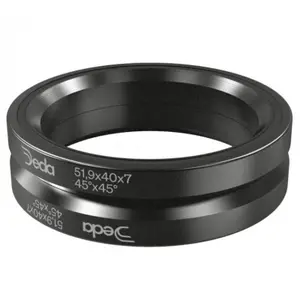


To replace the headset on your gravel bike, first identify its type, integrated, semi-integrated or external cup, then note its standard, for example IS42/28.6 at the top and IS52/40 at the bottom on a tapered steerer. This page brings together complete headsets, upper and lower halves, bearings and fitting tools, including models that let cables and hoses pass through.
What does a gravel bike headset do?
The headset is the set of bearings housed in the frame's head tube: it lets the fork turn freely while holding it without play. On a gravel bike, it absorbs the vibrations of tracks, hard braking on descents and spray from water and mud. A worn headset gives itself away with a knock under braking, steering that sticks in a straight line or a tight spot when you turn the handlebar. It is rarely replaced in its entirety: changing the bearings is often enough, provided you find exactly the same dimensions.
Integrated, semi-integrated or external: bike headset types
- Integrated: the bearings sit directly in seats machined into the frame, without a cup, so the frame must be designed for it.
- Semi-integrated, also known as zero stack: the bearings stay inside the head tube, but in press-fitted cups.
- External cup: the cups protrude from the head tube, at the top and bottom. They are found on steel frames and older bikes, or at the bottom only, to take a tapered fork in a narrow head tube.
Bikes with a threaded steerer and a quill stem use a threaded headset, which is rarer on a gravel bike.
Gravel bike headset size: reading the IS, ZS and EC standards
Most manufacturers describe their headsets with the SHIS code. The letters give the type, IS for integrated, ZS for semi-integrated, EC for external cup, and the first number the diameter of the seat in the frame, in millimetres. The number after the slash concerns the fork: at the top, it gives the steerer diameter, 28.6 for a 1 1/8-inch steerer; at the bottom, it indicates the crown race, 30 for a straight 1 1/8-inch fork, 40 for a tapered fork that flares to 1.5 inches.
A typical gravel bike therefore has a headset marked IS42/28.6 at the top and IS52/40 at the bottom. The two halves are sold together or separately: note both codes, or measure the seat with callipers, before you order.
Cable routing, fitting and adjustment
Many recent gravel bikes route cables and brake hoses through the head tube, just in front of the steerer, to tidy up the cockpit. The headset must then leave room for them: a specific upper bearing, and spacers and a top cover that are split or designed to guide the cables. Replace it with a reference compatible with your frame, often given by the bike manufacturer. On other models, the height of the top cover, from a few millimetres to more than two centimetres, changes the height of the handlebar: take this into account if you want to keep your position.
The cups of a semi-integrated or external headset are pressed in with a dedicated headset press, and a new or repainted frame may need its head tube faced and reamed. Adjustment is done with the top cap, before tightening the stem: the steering must turn without tight spots and without play. To check, apply the front brake with one hand, place the other hand on top of the head tube and rock the bike: the slightest knock signals play to take up.
Gravel stems, handlebars and steering
The headset is chosen together with the gravel stem that clamps the steerer and the gravel handlebar it holds; the whole cockpit is in our gravel components. Depending on your bike, road bike headsets and MTB headsets offer other standards.
Which brands for a gravel bike headset?
Funn offers its Descend headset in most standards, from ZS44/28.6 to EC44/40 or IS42/IS52, and as a lower half only, to replace just the bottom bearing.
Black Bearing classifies its headsets by seat and steerer diameter, from 34 to 56 mm, and offers upper halves designed for integrated or semi-integrated cable routing.
Cyclus supplies the workshop tools for fitting, such as its cutters that prepare the head tube before an integrated or semi-integrated headset is installed.
Ritchey, an American brand based in Reno that equips road, gravel and mountain bikes, offers its headsets in Comp and WCS finishes, external cup, semi-integrated or integrated, as well as separate upper or lower halves.
FSA covers many standards with its Orbit range, integrated, semi-integrated or external, and top covers of different heights, as well as a model intended for cyclocross.
CeramicSpeed, the Danish bearing manufacturer based in Holstebro, offers headsets with coated bearings, each designed for specific frames.
Gravel bike headsets on sale
End-of-line models move to our road clearance, which also takes gravel parts, and the latest arrivals are gathered in new arrivals. The winter sales are a good time to plan a headset service.
Frequently asked questions
Where can I find the headset standard for my gravel bike?
Look up the frame's technical specifications: most manufacturers give the SHIS code for the top and bottom. Otherwise, remove the fork and measure with callipers the outside diameter of each bearing and the angle of its bearing surfaces, often 36 or 45 degrees.
What are the signs of a worn headset?
When the steering has play despite correct adjustment, catches in the central position or creaks. A bearing that turns with notches or has rusted after rides in the rain must be replaced.
Can you replace just the bearings?
Yes, on an integrated headset, it is usually enough to replace the two bearings with models of the same diameter, thickness and angle. On a semi-integrated headset, the bearings are often sold on their own as well; the cup only needs changing if it is damaged.
Can a tapered fork be fitted to a straight head tube?
Only if the head tube can take the 1.5-inch bearing at the bottom: a headset with an external lower cup allows this on some 44 mm frames. Check compatibility with the frame manufacturer, as the geometry also changes.
Should you grease a headset?
Yes: a thin layer of grease on the bearing surfaces and cups protects against corrosion and creaking. Cartridge bearings are protected by seals, but cleaning and regreasing their seats after muddy rides extends their life.







