
Road bike disc brakes and brake rotors


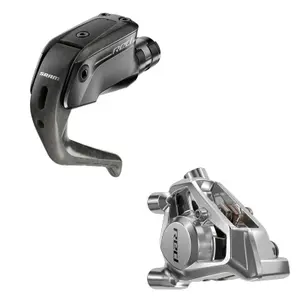


Road bike disc brakes stop just as effectively in the rain as in the dry and no longer wear out the rim. To fit them to a bike or renew them, choose the system, hydraulic or cable-operated, compatible with your levers, then the rotor: 140 or 160 mm in diameter, 6-bolt or Center Lock fitting. Complete brakes, calipers, rotors and adapters are gathered here.
Why disc brakes on a road bike rather than rim brakes?
A disc brake moves braking from the rim to a rotor fixed to the hub. The result: consistent power whatever the weather and the temperature of the rim, finer modulation on long descents and rims that no longer wear. It has also freed up room for wider tyres. In return, it requires a frame and fork designed for disc calipers, most often with thru-axles, and wheels with disc hubs.
Hydraulic, mechanical or semi-hydraulic?
- Hydraulic: the lever pushes fluid through a hose to the caliper pistons. It is the most powerful system and the easiest to modulate, and the pads move closer to the rotor on their own as they wear. Lever, hose and caliper form a single unit: they use the same fluid and are bled together.
- Mechanical: a conventional cable operates the caliper. Less powerful, it is fitted with cable levers, can be repaired anywhere and never needs bleeding; on the other hand, you have to take up pad wear by hand.
- Semi-hydraulic: the cable operates a small hydraulic circuit housed in the caliper. It brings some of the comfort of hydraulics while keeping your cable levers.
A hydraulic brake is often sold as a kit, with lever and caliper already connected and bled: the hose is shortened to the length of the bike, which then requires a bleed if the circuit is opened.
Brake rotors: diameter, fitting and thickness
On the road, rotors measure 140 or 160 mm. A flat mount caliper is designed from the outset for a 140 mm rotor; an adapter moves it out for a 160 mm rotor, which many cyclists choose at the front, or at both ends for heavier riders and long mountain descents. The rotor attaches to the hub in two ways: with six bolts, or with Shimano's Center Lock system, splined and held by a lockring. A Center Lock hub can take a 6-bolt rotor with an adapter, but not the other way round.
The rotor wears, more slowly than the pads. Its minimum thickness is given by the manufacturer, often engraved on the rotor: measure it with a vernier gauge and replace the rotor below this value, or if it is warped to the point of rubbing despite adjustment.
Rubbing, noise, bedding in: routine maintenance
A rubbing rotor often comes from a caliper knocked out of line after the wheel has been removed: loosen its two bolts, squeeze the lever so that the caliper centres itself on the rotor, then tighten again. If the noise persists, check that the rotor is not warped and that the pistons retract properly. A brake that squeals or loses power has often been contaminated by a lubricant or a cleaning product: clean the rotor with isopropyl alcohol and replace the contaminated pads. New pads and rotors are bedded in with a series of progressive stops, without locking the wheel, before the first descent.
Calipers, levers and other braking parts
To replace only the part that clamps the rotor, see road brake calipers, and for the controls, road brake levers, which often include the gear shifting. A rim-brake bike is better served by road brake pads. Road bike brakes brings everything together, and gravel disc brakes are designed for tracks and trails.
Which disc brake brands to choose?
Sram, headquartered in Chicago, offers flat mount hydraulic road brakes in its Red, Force, Rival and Apex groupsets, and adds for mountain biking the Level, Code, Motive and Maven ranges featured on this page.
Shimano fits its 105, Ultegra and GRX groupsets with mineral oil hydraulic brakes and offers a wide range of rotors in 6-bolt, such as the SM-RT56, or in Center Lock, such as the RT-EM300.
Clarks Cycle Systems, a British cycle parts manufacturer based in Derby, offers complete hydraulic brakes and the CHM-05, a semi-hydraulic brake supplied with rotor and adapter.
TRP, Tektro's high-end brand, is present with the Spyre mechanical caliper, in flat mount or SLC versions, the cable-operated HY/RD semi-hydraulic caliper, and flat mount hydraulic brakes.
Formula, an Italian brand also known for its forks and shocks, develops its Cura family of two or four-piston hydraulic brakes, in Cura, Cura X and Cura 4 versions.
Disc brakes on sale and new arrivals
When a road groupset moves to a new generation, its brakes join our road braking clearance; it is a chance to pick up a second set of rotors. New arrivals present recent models, and Black Friday and the summer sales are among the highlights.
Frequently asked questions
What rotor size should you choose for a road bike?
160 mm at the front and 140 mm at the rear is the most common set-up. 160 mm at both ends gives heavier riders and mountain riders extra margin; 140 mm at the front suits light bikes and slim riders. Respect the maximum diameter allowed by your frame and fork.
How long does a bike brake rotor last?
It depends on the terrain, the weight and the pads used, but a rotor generally outlasts several sets of pads. Metallic pads wear it faster than organic ones. Measure its thickness from time to time rather than relying on mileage.
Does a hydraulic disc brake need much maintenance?
Very little: check pad wear, keep the rotor clean and bleed the circuit when the lever feels spongy or its travel lengthens, which rarely happens on a healthy circuit. Never mix two brake fluids.
Why does my disc brake squeal in the rain?
Water and mud thrown between rotor and pads often cause a temporary squeal, which disappears once the brakes have dried. If it persists in the dry, look for contamination or a misaligned caliper.
Do you need specific wheels for disc brakes?
Yes: the hubs must have a rotor mount, 6-bolt or Center Lock, and match the frame's axles, often thru-axles. A wheel designed for rim brakes cannot take a rotor.







