
Bike kickstands: adjustable, side or double


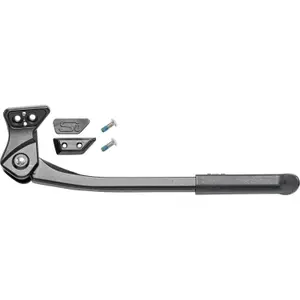


A bike kickstand is chosen on three criteria: where it mounts on your frame, the size of your wheels and the weight it will have to hold. A side kickstand for everyday use, a double kickstand for a loaded bike or an e-bike, it also comes in adjustable versions that fit several wheel sizes. Kickstands, replacement feet and adapters are all on this page.
Side, rear or double: which kickstand for which bike?
- Centre-mount side kickstand: fixed just behind the bottom bracket, it tilts the bike to one side. It is the most common fitting on city bikes, touring bikes and hybrids.
- Rear-mount side kickstand: fixed near the rear wheel, on the chainstay and seatstay or directly on the axle, it suits frames with no mounting plate, including many mountain bikes and kids' bikes.
- Double kickstand: its two legs hold the bike upright. More stable, it suits a bike loaded with panniers or fitted with a child seat, an e-bike and a cargo bike.
The choice depends as much on your frame as on how you use the bike: a bike parked for a few minutes outside a shop does not have the same needs as a touring bike that you load while it is stationary.
Mounting and hole spacing: what your frame accepts
Many city and touring bikes have a small plate with two threaded holes under the chainstays, behind the bottom bracket. The distance between these holes, known as the hole spacing, is most often 18 mm, sometimes 40 mm: it appears in the name of many kickstands on this page. Without a plate, other solutions exist: a clamp tightened around the chainstays, a fixing on the seatstay, on the rear axle or between the bottom bracket and the frame. Some frame manufacturers require an adapter specific to their models. With a rear disc brake, check that a rear kickstand touches neither the caliper nor the rotor.
Wheel size, length and load
Each kickstand states the wheel sizes it covers, for example from 24 to 28 inches, or from 16 to 20 inches for a kids' bike. Adjustable models are set with a screw or a telescopic leg, while others are cut to the right length. Adjust it so that the bike leans slightly: too long, it stands the bike up and it tips over on the other side; too short, the bike lies down. The permitted load also matters: a kickstand for a kids' bike is designed for a low weight, whereas a heavier e-bike calls for a reinforced model. Replacement feet, wider or non-slip, improve stability on soft ground.
Kickstands for e-bikes and cargo bikes
An e-bike is much heavier than a non-assisted bike, all the more so when loaded. Its kickstand therefore has to be reinforced, ideally fixed to a plate or a point provided by the manufacturer. The mid-drive motor often takes up the usual place of a centre-mount kickstand: some kickstands then fix to a dedicated interface or at the rear. For a cargo bike or a bike that carries a child, a double kickstand remains the safest choice, as it keeps the bike upright during loading.
Mudguards and other bike protection
The kickstand protects your bike by saving it from being laid on the ground. To stay clean in the rain, see mudguards; to signal your presence and keep an eye on what is behind you, mirrors and bells. Everything is gathered in bike protection.
Bike kickstand brands
Ursus, an Italian company that also makes wheels, hubs and handlebars, covers most fitting types: the Mooi fixes to the seatstay, the Jumbo Evo and the Jumbo are double kickstands, the Kaiser takes wheels from 26 to 29 inches and the Elegance comes in a version for kids' bikes.
XLC offers solutions for special cases: an adjustable kickstand for kids' bikes, the KS-R07, a kickstand that fixes to the bottom bracket, the KS-B01, and adapter plates designed for certain frames from the Ghost brand.
Pletscher, a Swiss manufacturer that designs and produces racks, kickstands and mudguards under one roof, has given its Twin double kickstand two legs that fold up on the same side; the Comp Ara, fixed to the seatstay, folds up automatically.
Kellys, a bike manufacturer, offers its Kick range of kickstands, from the Kickstart to the E-Kick, and sells the replacement brackets for its Kicker and Doublekick models separately.
Hebie, one of the oldest kickstand specialists, makes its models in Bielefeld; here you will find the double lite rex, the Hebert fixed to the rear axle and the fix 18, for a plate with 18 mm hole spacing.
Bike kickstands on sale
End-of-line kickstands are grouped in bike protection clearance, along with mudguards and accessories; references that have just arrived are in new arrivals. The summer sales, before holiday rides, are a good time to equip a touring bike.
Frequently asked questions
Can you fit a kickstand to a mountain bike?
Yes, but rarely on a plate: mountain bikes almost never have one. Choose a rear kickstand fixed with a clamp on the chainstay or on the wheel axle, checking the clearance for the disc brake. On a full-suspension bike, only a few models are designed to fit without hindering the suspension travel.
Which kickstand for a 20-inch bike?
Choose a kickstand whose adjustment range includes 20 inches, often sold for wheels from 16 to 20 or from 20 to 24 inches. Check the permitted load and the mounting method: on many kids' bikes, it fixes at the rear, near the axle.
Can a kickstand damage the frame?
A clamp overtightened on thin chainstays can mark or crush them, particularly on a carbon frame, which only accepts a kickstand at a point provided by the manufacturer. On an aluminium or steel frame, tighten gradually and fit the protective pad supplied.
Why does my bike fall over despite the kickstand?
The length is often to blame: adjust it so that the bike leans clearly. On soft ground, a wider foot stops it sinking in, and on a heavy or loaded bike, a double kickstand is more reliable. A handlebar that swings round can also unbalance the bike: turn it towards the side of the kickstand.
Do you need a double kickstand for an e-bike?
No, a reinforced side kickstand is fine for everyday parking. A double kickstand becomes invaluable if you load panniers, carry a child or often park the bike on sloping ground.







