
Child bike seat, front and rear


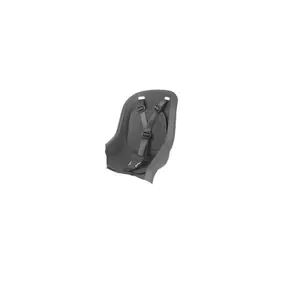
A child bike seat carries your child as soon as they can sit up unaided and support the weight of a helmet. Front seat between your arms, rear seat fixed to the frame or the pannier rack, junior seat for older children: check your child's weight, the fitting that suits your bike and compliance with the EN 14344 standard.
From what age and up to what weight?
The European standard EN 14344 covers bike seats for children from 9 to 22 kg who can sit up unaided, on conventional bikes as well as on e-bikes assisted up to 25 km/h. Within this range, front seats generally stop at 15 kg, around the age of 3, and rear seats go up to 22 kg, around the age of 6. Beyond that, junior seats take over: the Polisport Guppy Junior, for example, takes children from 22 to 35 kg, from the age of 6 and 1.10 m tall.
In the UK, the Highway Code states that you must not carry a passenger unless your bike has been built or adapted to carry one, which is the role of a child seat. The law there does not require a helmet, but a correctly sized, securely fastened helmet remains advisable, whether the child is pedalling or riding in a seat. Rules vary from one country to another, so check those that apply where you ride.
Front or rear child bike seat?
A front seat places the child between your arms: they enjoy the view, you can talk to them, and their weight stays in the centre of the bike. It means riding with your knees slightly apart and suits the youngest children. Some models designed for mountain biking seat the child upright, with their hands on your handlebar. A rear seat takes heavier children, leaves your riding position unchanged and comes in a reclining version for naps.
Fitting on the frame, the pannier rack or MIK HD
- On the frame: a bracket clamped to the seat tube holds the rear seat by two bars. It is the solution for bikes without a suitable pannier rack, provided the seat tube leaves enough room for the bracket.
- On the pannier rack: the seat clamps onto the rack tubes, and the rack must comply with the ISO 11243 standard and accept the minimum load set by the seat manufacturer.
- On a MIK HD pannier rack: the seat clicks on and comes off in one movement, but only on a MIK HD rack, often fitted as standard.
- At the front: a plate fixes to the head tube or under the stem, or an adapter fits on the fork steerer without touching the frame.
Safety and comfort: the points to check
A height-adjustable three- or five-point harness, adjustable footrests with straps and a wheel guard keep hands and feet away from moving parts. Avoid a saddle with exposed springs, where little fingers can get caught. A backrest that leaves room for the helmet, a washable cushion and a reclining position make long journeys more pleasant. When stopped, a double kickstand keeps the bike stable while you settle the child in, and a rain cover protects the seat when the bike stays outside.
Trailers, bike racks and bags
For two children or a toddler, a bike trailer carries them under cover. When the rear seat takes up the pannier rack, a handlebar or frame bag takes over for your belongings: see bike bags, and for what you carry yourself, cycling backpacks and bags. To take the family's bikes on holiday, see the bike racks, and everything together in the bags and transport category.
Child bike seat brands
Polisport, a Portuguese manufacturer, accompanies the child at every age: Koari, Guppy and Bilby rear seats for the pannier rack or the frame, then the Guppy Junior for children from 22 to 35 kg.
Urban Iki, a brand born in the Netherlands, takes the colours and names of its seats from Japanese culture, with five-point harnesses and adjustable footrests, in MIK HD, Easyfix or Compact front seat versions.
Bobike designs its seats in the Netherlands and has them produced in Portugal; its double-wall shell is found from the reclining Exclusive Evolve Maxi to the Go Maxi, which fixes to the frame or the pannier rack.
Thule, a Swedish brand, offers the Yepp Nexxt 2 range: the Mini at the front, up to 15 kg, and the Maxi at the rear, in a frame or pannier rack version.
Mac Ride, designed by mountain biking parents, seats the child upright between your arms, with their hands on your handlebar; its adapter fits on the fork steerer without touching the frame, which makes it compatible with carbon frames and dropper posts.
Hamax, a Norwegian manufacturer, offers the Zenith Relax for the pannier rack, whose backrest reclines with one hand thanks to a dial, without removing the seat.
Child bike seats on sale
A seat from the previous collection protects your child just as well: those leaving the catalogue are flagged in urban transport clearance, and the latest arrivals in new arrivals. Spring and the summer sales herald the first family rides.
Frequently asked questions
Up to what age can you use a child bike seat?
Weight counts more than age. A standard rear seat stops at 22 kg, around the age of 6 for most children. A junior seat extends use up to 35 kg, around the age of 10, on a pannier rack that supports the load required by the manufacturer.
How do you fit a child bike seat?
Follow the instructions step by step and tighten each fixing to the specified torque. Then check that the seat does not move, that the child's feet stay well away from the wheel and that your heels do not touch the seat when pedalling. Check again after the first few journeys.
Can you fit a child seat to an e-bike?
It is provided for: the EN 14344 standard includes e-bikes assisted up to 25 km/h. Everything depends on where the battery sits: if it is under the pannier rack, a seat fixed to the frame or a model compatible with that rack is the answer.
Can you take a child mountain biking?
On easy trails, yes, with a front seat designed for this use, which keeps the child in the centre of the bike and between your arms. Adapt your pace, avoid technical sections and check that the seat hinders neither the steering nor the dropper post.
How do you protect your child from the rain?
Dress them in a covering rain jacket and a helmet cover, and keep a dry cushion or a cover for the seat when the bike stays outside. In heavy rain or very cold weather, an enclosed trailer offers better protection.







